What is a speedometer and why is a speedometer so important?
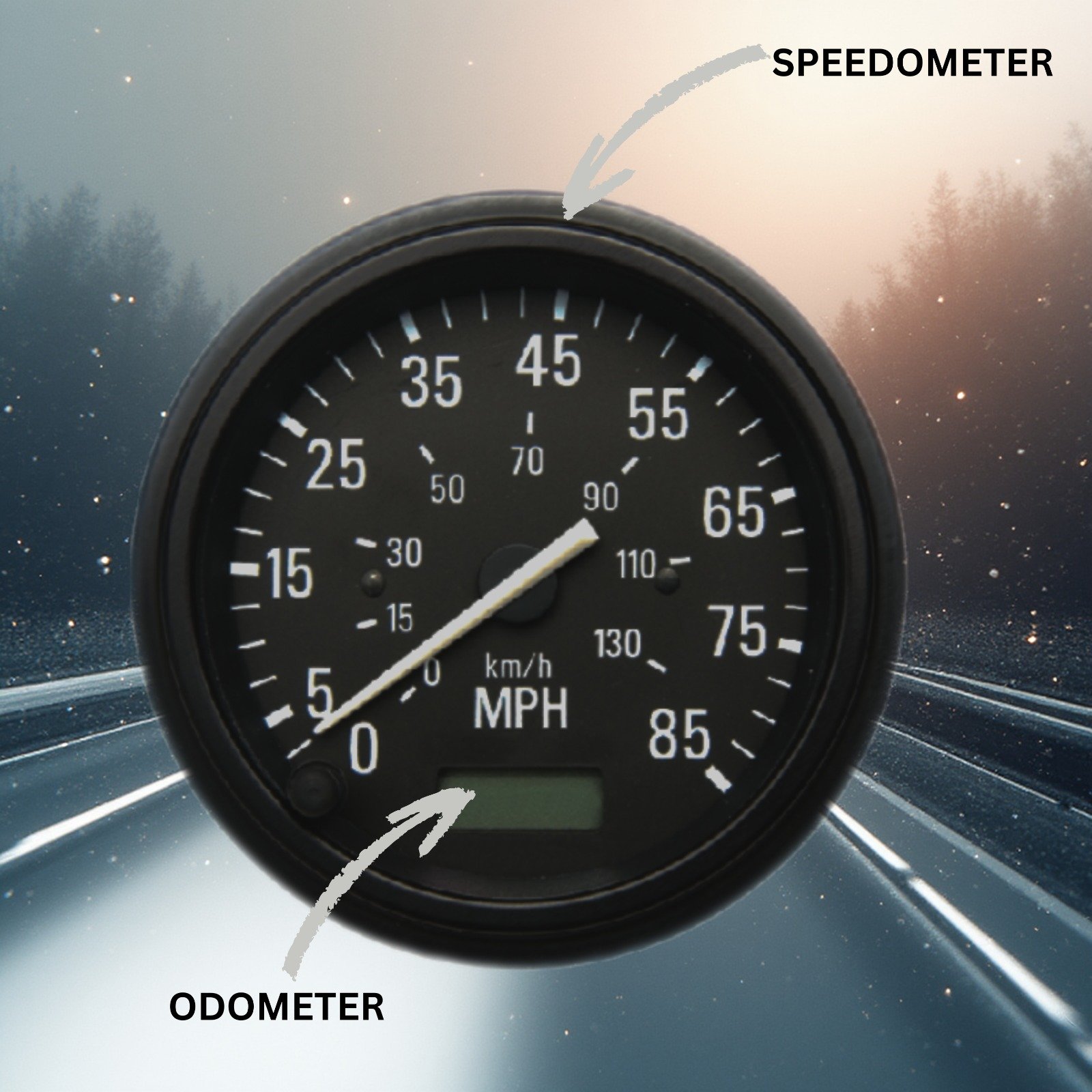
A speedometer is an instrument that displays the instantaneous speed of a vehicle, or to be more precise, the vehicle’s wheels.
Speedometers inform the user about how fast the vehicle is traveling at any given point. This can be in kilometers per hour (km/h) or miles per hour (mph).
A speedometer is a very important instrument in any vehicle, since drivers are supposed to follow speed limits while driving, and so they need to know the vehicle speed accurately.
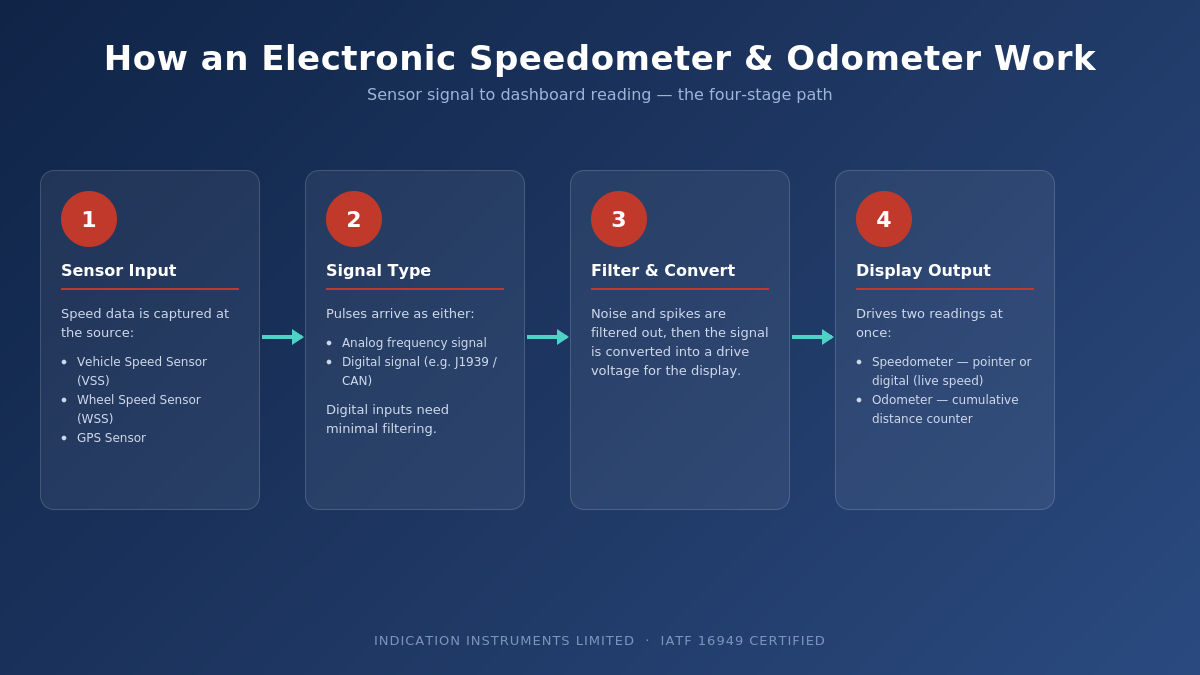
Odometer vs Speedometer: How They Work, and How OEMs Choose the Right One
A speedometer and an odometer sit side by side on almost every vehicle dashboard, but they answer two different questions. The speedometer tells you how fast the vehicle is moving right now. The odometer tells you how far it has travelled in total. For a driver, that distinction matters for safety and for resale value. For an OEM engineering or procurement team, it also decides which sensor inputs, calibration method, and display technology to specify when sourcing an instrument cluster. This guide covers both angles.
Odometer vs Speedometer: The Difference in One Line
A speedometer measures a vehicle’s current speed, usually derived from wheel RPM; an odometer measures the total distance travelled, calculated by counting wheel rotations over time. One is a live reading that changes constantly; the other is a cumulative total that only ever increases.
What Is a Speedometer and How Does It Work?
A speedometer displays the instantaneous speed of a vehicle — strictly speaking, the rotational speed of its wheels, converted into a familiar unit like km/h or mph. Drivers rely on it to stay within speed limits and to gauge how the vehicle is handling in real time.
By design, most speedometers are calibrated to read slightly higher than true road speed — typically within about ±2% of full scale — as a built-in margin that discourages unintentional overspeeding. The actual accuracy of that reading depends on more than the instrument itself: wheel RPM passes through gears and pulleys before it reaches the speedometer, and any deviation in those ratios from the original calibration shows up as reading error.
What Is an Odometer, and What Is a Trip Odometer?
An odometer is a separate instrument — even though it usually shares a housing with the speedometer — that totals the distance a vehicle has covered over its lifetime, shown in kilometres or miles. A trip odometer does the same job over a shorter, driver-defined window: it can be reset at will, which is why many vehicles offer two of them, one for daily driving and one reserved for tracking a specific journey, fuel-fill interval, or maintenance cycle.
Odometer data isn’t just a dashboard number. It’s the reference point for warranty tracking, scheduled-service intervals, fuel-efficiency calculations, and resale valuation — which is exactly why OEMs treat odometer accuracy and tamper-resistance as a specification, not an afterthought.
Why Odometer and Speedometer Readings Matter Beyond the Dashboard
For an individual driver, these two readings support safe driving and basic maintenance planning. For a fleet operator or an OEM building the vehicle in the first place, they carry more weight: odometer data underpins warranty claims and scheduled-maintenance triggers, speed data feeds into driver-behaviour and safety programs, and both are increasingly logged over CAN/J1939 for telematics and compliance reporting rather than just displayed on a dial.
Mechanical vs Electronic Odometers and Speedometers
- Mechanical: driven by a flexible rotating cable connected to the gearbox, moving a pointer for speed and rotating number wheels for distance. Simple, robust, and largely obsolete in new vehicle programs.
- Electronic: driven by sensor signals — analog or CAN-based — that are processed and used to drive either a stepper-motor/air-core pointer or a fully digital LCD readout. This is the standard for virtually all new commercial and passenger vehicle programs today.
What Feeds an Electronic Speedometer or Odometer?
Electronic units typically take their input from one of three sensors and switches, either directly or through the vehicle’s ECU:
- Vehicle Speed Sensor (VSS) — mounted at the gearbox or transmission output
- Wheel Speed Sensor (WSS) — the same sensor family used for ABS and traction control
- GPS Sensor — increasingly common where wheel-based sensing is unreliable or unavailable
These inputs may arrive as raw analog pulses or as digital signals such as J1939, which require far less filtering and generally deliver higher accuracy.
Speedometer vs Tachometer: Not the Same Instrument
It’s a common mix-up: a speedometer measures how fast the vehicle’s wheels are turning, converted to road speed; a tachometer measures how fast the engine’s crankshaft is turning, in RPM. The two numbers move together but are never identical, because gearbox and differential ratios sit between the engine and the wheels. If you’re specifying or troubleshooting engine-speed instrumentation specifically, see our companion guide: What Is a Tachometer and How Does It Work?
How Speedometers and Odometers Are Calibrated
For engineering teams specifying calibration parameters, the relationship between sensor pulses and displayed speed follows a fixed formula:
Input frequency at a given speed: f = (pulses per km × speed in km/h) ÷ 3600
Pulses per kilometre are derived from the sensor’s mechanical relationship to the wheel: Np/km = (gear ratio × sensor pulses per revolution × 1000) ÷ wheel circumference (m)
Example: with a gear ratio of 4, 8 pulses per revolution, and a 2 m wheel circumference, that works out to 16,000 pulses per kilometre.
Odometer distance is then simply total pulses received divided by pulses-per-kilometre, with digital displays typically incrementing in fixed steps (e.g. every 0.1 km) based on that same pulse count.
Choosing Speedometer & Odometer Technology for Your Vehicle Program
If you’re specifying instrumentation for a new vehicle platform rather than just troubleshooting one, the real decisions come down to three trade-offs:
- Sensor choice: GPS is highly accurate in open terrain but can lose signal in tunnels or dense cover; a Vehicle Speed Sensor is compact and reliable but sensitive to tyre-size or gear-ratio changes; a Wheel Speed Sensor gives the most precise, wheel-specific data and doubles up with ABS/traction systems, but needs clean operating conditions.
- Actuation: stepper-motor movements offer higher accuracy and self-test capability at a higher cost; air-core movements respond faster and cost less, at a small trade-off in long-term accuracy.
- Display: analog pointer displays are easier to read at a glance during dynamic driving; digital 7-segment displays are more precise and legible in low light, with no parallax error.
Indication Instruments Limited designs and manufactures both mechanical and fully electronic speedometer and odometer instrumentation — for trucks, buses, tractors, construction equipment, and specialty vehicles — under IATF 16949 quality standards, for OEM programs across India and export markets. Explore our full instrument cluster range or talk to our engineering team about a custom specification.
Frequently Asked Questions
What does an odometer measure?
The total distance a vehicle has travelled over its lifetime (or since a trip odometer was last reset), measured in kilometres or miles by counting wheel rotations.
What does a speedometer measure?
The vehicle’s current speed, derived from the rotational speed of the wheels and converted to km/h or mph.
What distinguishes a speedometer from a tachometer?
A speedometer measures vehicle wheel RPM and converts it to road speed; a tachometer measures engine RPM directly. The two differ because of gearbox and differential ratios between the engine and the wheels.
How does an electronic speedometer or odometer work?
It takes analog or digital pulses from a speed sensor, filters the signal, and uses it to drive either a stepper-motor/air-core pointer or a digital display. Digital inputs such as J1939 need minimal filtering and are typically more accurate.
Why do tractors and off-road vehicles have speedometers if road speed limits don’t apply to them?
For operator convenience and safety — consistent speed matters for tasks like ploughing, seeding, or towing, and many tractors are also road-legal for limited transport between farms, where speed indication is expected.
What is the advantage of a stepper-motor speedometer over an air-core one?
Stepper motors offer higher accuracy and built-in self-test capability; air-core designs respond faster to changes and cost less to produce.
How are speedometers and odometers calibrated?
Through a fixed relationship between sensor pulses per kilometre and vehicle speed — see the calibration formulas above. Gear ratio, sensor pulses per revolution, and wheel circumference all factor into the calculation.
What’s the relationship between speed and distance?
Distance equals speed multiplied by time. At constant speed, the odometer’s cumulative reading rises in direct proportion to the speedometer’s instantaneous reading over that period.