


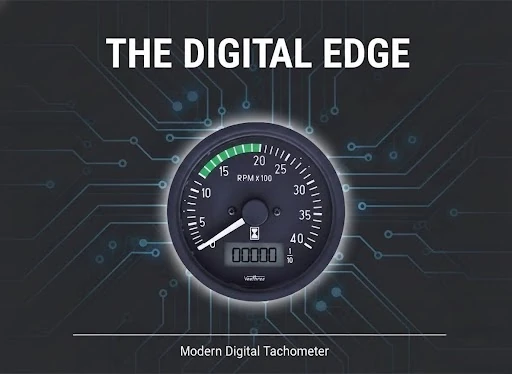
A tachometer measure the RPM of petrol and diesel engines. It takes an input from various signals like ECU / ignition coil / alternator or a magnetic pick up sensor , filters the input and converts it internally to drive a pointer or a digital display to indicate the RPM.
What applications / vehicles does IIL make Tachometers for ?
IIL makes tachometers for use in mobility as well as non mobility based applications. A tachometer can be used anywhere where there is a petrol or diesel engine being used. Mobility applications include on road applications such as specialty cars, hot rods, trucks and buses; off road applications such as farm equipment, tractors and construction equipment. The stationary or non mobility applications include generators, compressors and many other applications using IC engines.
Purpose of Tachometers in Vehicles
Tachometers measure speed in revolutions per minute (RPM). These give the user real time RPM of engine while driving the vehicle or operating the equipment. In case of mobility based applications, they can help the driver avoid over-revving, make the proper gear shifts, and preserve fuel efficiencies, hence improving driving performance and extending engine life . In case of race car applications, the driver may want to rev the engine as high as possible and the tachometer helps give him the adrenaline high by indicating how high the RPM went. In stationary applications, the tachometer is a useful preventive or even predictive maintenance tool, since over-revving trends may indicate clutch or transmission issues.
How Does a Tachometer Work?
There are two kinds of tachometers in terms of input, i.e. mechanically driven and electronically driven tachometers. Mechanical tachometers accept input from the engine through physically rotating flexible cable which is usually mechanically inserted inside the tachometers. This is an old technology, so we wont go into further detail.
Electronic Tachometers in turn can be further divided into two categories, i.e. those which accept analog signals and those which accept digital signals. Analog signals are in the form of frequency coming from the alternator, crankshaft, or ignition system of the engine. This signal is filtered to remove noise , spikes, etc. and after this the frequency is convert into a voltage, which drives the air core movement / stepper motor which in turn move the pointer; or in case of a digital output drive a digital display. Some electronic tachometers accept digital inputs for example a J1939 output . The digital input requires minimal filtering and it too is converted to an analog voltage which drives the pointer / display
What are the types of analog input signals to tachometers?
Tachometers accept analog inputs from following sources :
Alternator
Inputs are taken from the W terminal which connects to the alternator stator winding.
The number of pulses per revolution depends on the alternator’s pole count, and also the ratio of the diameters of the alternator pulley and engine pulley. The accuracy may not be very good if the belt connecting alternator to engine slips.
Ignition Coil
In spark-ignition engines, the coil primary or secondary circuit provides sharp voltage pulses for each ignition event. The tachometer counts these pulses and converts them into engine RPM.
Magnetic Pickup (Mag Pick-up) sensor
Produces sinusoidal pulses as teeth pass by, directly proportional to RPM. This is commonly used in diesel engines where no ignition coil is present.