


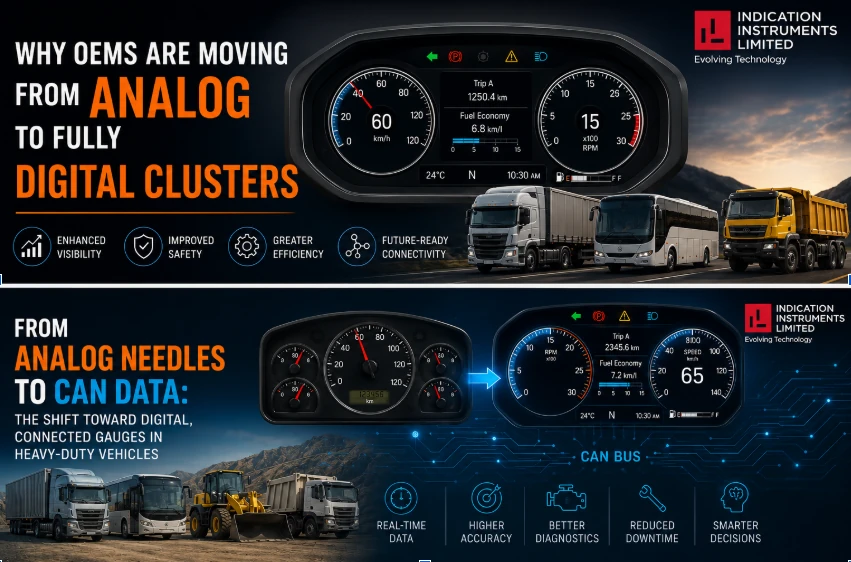
What’s the Difference Between an Analog Gauge and a Digital, CAN-Connected Gauge?
An analog gauge reads a physical signal directly-such as a sender unit’s resistance or a mechanical pressure signal-and moves a needle proportionally. A digital, CAN-connected gauge, on the other hand, reads data broadcast over the vehicle’s CAN bus, often using the SAE J1939 protocol, and displays it through a stepper-motor pointer, LCD readout, or bar graph. While the mechanical appearance may be similar, the underlying architecture is very different-and CAN-connected gauges offer significantly greater flexibility and functionality.
Why Are Heavy-Duty Vehicles Moving Toward CAN-Based Gauges?
The instrument cluster market is evolving from traditional analog systems toward increasingly advanced digital formats, driven by the adoption of connected and software-enabled technologies across the automotive sector. For heavy-duty and off-highway vehicles, CAN-based gauges address a key limitation of conventional analog wiring. A single CAN bus can transmit multiple parameters-such as fuel level, DEF/AdBlue level, engine hours, and fault information-through a shared communication network rather than requiring dedicated wiring and sensors for every gauge. This can simplify wiring harnesses while also providing greater access to vehicle data and diagnostics.
Does Electrification Change What Gauges Need to Display?
Significantly. The growing adoption of EVs, connected vehicles, and software-defined vehicle technologies is changing the type of information operators need to monitor. Traditional fuel and coolant-temperature gauges may not be suitable for battery-electric or hydrogen-powered equipment. A CAN-connected digital gauge, however, can be configured to display parameters such as battery state of charge, motor temperature, or hydrogen tank pressure without necessarily requiring a change to the physical gauge hardware. This flexibility is one reason IIL’s J1939 gauges are designed with reprogrammable display configurations rather than fixed mechanical scales.
Are Analog Gauges Becoming Obsolete?
Not entirely-and OEMs should not assume that digital is automatically the right solution for every application. Simple, cost-sensitive applications such as basic gensets and entry-level construction equipment can still benefit from mechanical temperature and pressure gauges. These applications may not require CAN integration, making analog gauges a cost-effective and straightforward option. The shift toward digital is strongest when a vehicle already uses a CAN network for systems such as the engine ECU, transmission, or telematics. In these cases, using existing CAN data for instrumentation can be more efficient than adding separate analog sender wiring.
What Are the Practical Benefits of CAN-Connected Gauges for Fleet Operators?
- Fewer wiring-related failures - A single CAN connection can replace multiple analog sender wires, reducing potential failure points in vibration-heavy operating environments.
- Richer diagnostics - Fault codes, warning thresholds, and other diagnostic information can be incorporated into the gauge display rather than relying solely on separate warning indicators.
- Easier calibration - Configurable pulse and threshold settings can allow calibration changes to be made without replacing the gauge.
- Consistent vehicle data - CAN-connected gauges and digital displays can use the same underlying vehicle data, reducing the need for duplicate sensors.
How Should OEMs Decide Between Analog and Digital Gauges?
The decision generally comes down to three questions:
- Does the vehicle already use a CAN 2.0B or J1939 network?
- Does the application require configurable thresholds or multi-parameter displays, such as a combined fuel/hour meter?
- Does the OEM require field-level diagnostics and configuration, rather than simply displaying a basic reading?
If the answer to one or more of these questions is yes, a CAN-connected digital gauge may provide greater long-term flexibility, even if its initial cost is somewhat higher than an equivalent analog gauge.
What Should OEMs Verify Before Specifying a Digital Gauge Supplier?
Before selecting a supplier, OEMs should verify:
- Confirmed support for the exact communication protocol in use - CAN 2.0B or J1939 - rather than simply specifying a product as “CAN compatible.”
- ISO 16750 compliance with documented test reports covering vibration, dust, water, temperature, and humidity resistance.
- Field-configurable pulse and threshold settings, eliminating the need to reorder hardware when calibration requirements change.
- Availability of both analog and digital gauge solutions, ensuring that simpler applications are not unnecessarily over-engineered.
Why Do OEMs Choose Indication Instruments Limited for Gauge Instrumentation?
IIL manufactures both analog and digital gauges, including speedometers, tachometers, J1939 gauges, and hour meters. Its gauge solutions are designed for 9V-32V compatibility across 12V and 24V vehicle electrical systems, with IP65 and ISO 16750-2-compliant construction. As a single-vendor supplier for gauges, digital displays, instrument clusters, and sensors and switches, IIL can support OEM programs ranging from straightforward mechanical instrumentation to fully CAN-connected systems. OEMs can review IIL’s quality certificates and product catalogues when evaluating instrumentation solutions.