Powered by Smartsupp Blog Archives - Indication Instruments Ltd.
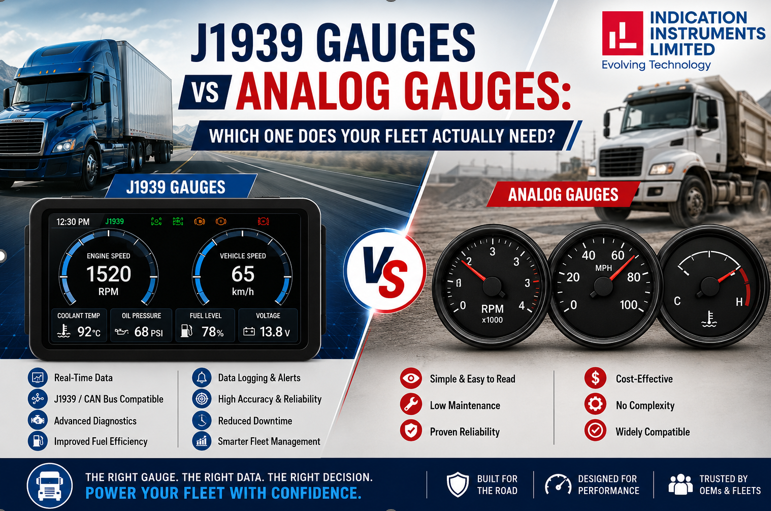
Digital Gauges vs Mechanical Gauges in Heavy Machinery: A Technical Comparison

Digital Gauges vs Mechanical Gauges in Heavy Machinery: A Technical Comparison

Digital Gauges vs Mechanical Gauges in Heavy Machinery: A Technical Comparison

Introduction: Why the Gauge Choice Is Really a System Design Choice

A few years ago, I spent an afternoon in a hydraulic system test cell comparing readings from a legacy mechanical Bourdon tube pressure gauge and a digital pressure transducer connected to a display module, both measuring the same hydraulic circuit simultaneously. The mechanical gauge was reading 3.8 bar when the transducer was showing 3.6 bar. The transducer was right. We confirmed it with a calibrated reference. The mechanical gauge, which had been in service for eleven years, had developed a calibration error of approximately five percent.

The facility maintenance team was surprised. The gauge looked fine. The needle moved smoothly. No one had flagged it as a problem. It had simply drifted, as mechanical gauges do, without any visible indication that its readings were no longer accurate.

That afternoon crystallized something I had seen across many heavy machinery applications: the choice between digital and mechanical gauges is not really a choice between display technologies. It is a choice between measurement philosophies. Mechanical gauges are direct-reading devices that convert physical force into mechanical movement. Digital gauges are signal processing chains that convert physical measurements into digital values, process them, and render them on a display. Each approach has distinct accuracy, reliability, integration, and lifecycle characteristics that make one or the other more appropriate depending on the application.

This post covers both technologies honestly, including their respective limitations, and provides the comparison framework that should drive gauge selection decisions in heavy machinery applications.

How Mechanical Gauges Work and Their Inherent Limitations

Understanding the mechanical gauge’s strengths and weaknesses starts with understanding its operating principle. The most common mechanical gauges used in heavy machinery fall into three categories.

Bourdon tube pressure gauges: A curved metal tube sealed at one end. When pressure is applied to the open end, the tube tends to straighten. This straightening motion is transmitted through a mechanical linkage to a rotating indicator needle. The gauge requires no power source and its reading is directly proportional to the applied pressure. Its accuracy is typically specified as plus or minus 2 to 3 percent of full scale per EN 837 or ASME B40.100, and it maintains that accuracy when new and properly installed.

Bimetallic strip temperature gauges: Two metals with different coefficients of thermal expansion bonded together. When temperature changes, the differential expansion causes the strip to bend, driving a needle movement. Bimetallic gauges are used for lower-accuracy temperature monitoring in applications where the primary requirement is a go or no-go indication rather than a precise measurement.

Mechanical tachometers: Cable-driven or magnetic reluctance devices that convert shaft rotational speed into needle deflection. The mechanical connection between the rotating shaft and the needle introduces both wear over time and a response lag that makes reading transient RPM changes less precise than electronic alternatives.

The fundamental limitations of mechanical gauges follow from their physical operating principles. Mechanical linkages wear over time, introducing backlash and hysteresis that degrade accuracy. Vibration in heavy machinery applications causes needle oscillation that makes precise reading difficult. Temperature effects on the gauge mechanism itself can cause reading errors distinct from any error in the measured parameter. And critically, there is no output signal. A mechanical gauge reading cannot be logged, transmitted to a telematics platform, or used to trigger an automated alarm. It exists only as a local visual indication.

How Digital Gauges Work

A digital gauge system consists of an electronic sensor (the measurement element), a signal conditioning circuit, a processing unit that converts the sensor signal to a calibrated engineering value, and a display element. In modern vehicle and machinery applications, the processing and display functions are typically handled by the instrument cluster or display module, while the sensor itself is mounted at the measurement point.

Pressure transducers: Most digital pressure measurement uses piezoresistive silicon strain gauge sensors bonded to a diaphragm. Applied pressure deflects the diaphragm, changing the resistance of the strain gauges in a Wheatstone bridge configuration. The bridge output is amplified and processed by signal conditioning electronics to produce a calibrated 4 to 20mA, 0.5 to 4.5V, or CAN output signal proportional to pressure. Accuracy specifications are typically plus or minus 0.5 percent or better of full scale, significantly better than a comparable mechanical gauge.

Temperature sensors: NTC (Negative Temperature Coefficient) thermistors and PT100/PT1000 resistance temperature detectors (RTDs) are the most common digital temperature sensing elements in heavy machinery applications. NTC thermistors provide high sensitivity with a non-linear resistance-temperature characteristic that ECU calibration tables compensate. RTDs provide a more linear response with higher accuracy, typically plus or minus 0.1 degrees C, suited to precision temperature monitoring in critical fluid circuits.

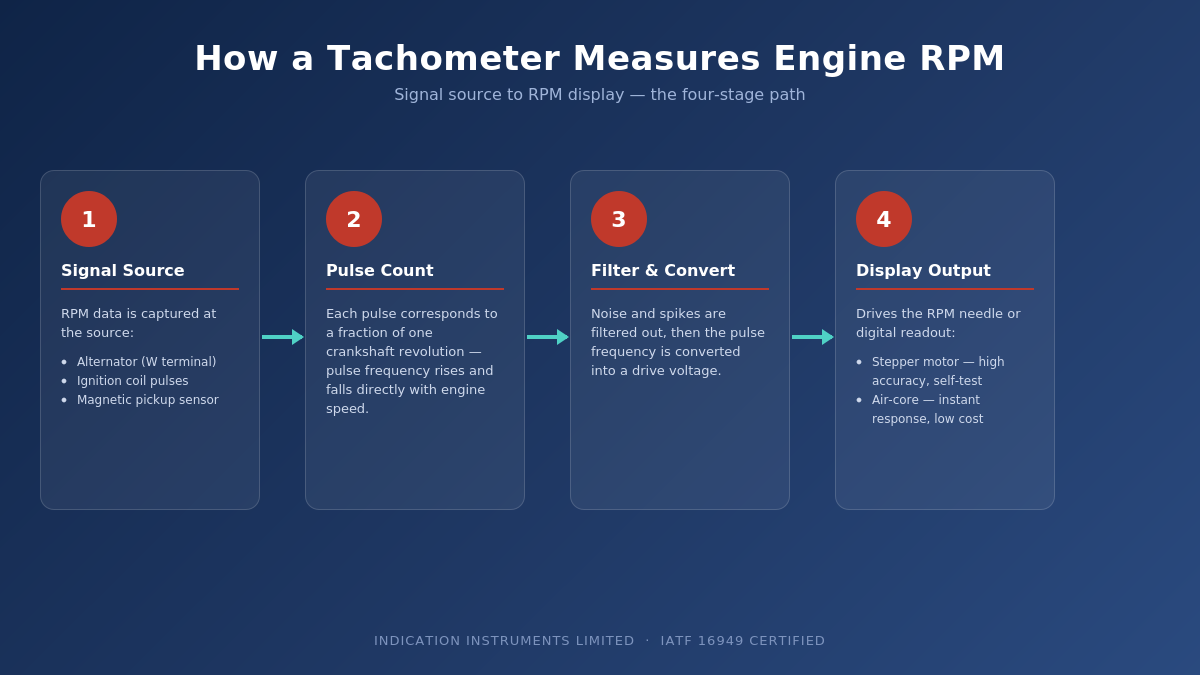
Digital tachometers: Magnetic reluctance or Hall effect sensors count teeth on a gear wheel or pulses from a target wheel mounted to the rotating shaft, producing a frequency output that is digitally converted to a precise RPM value. Response time is limited only by the pulse count rate, making digital tachometers far more responsive to transient RPM changes than any mechanical alternative.

Accuracy and Reliability: A Direct Comparison

The performance difference between modern digital gauges and mechanical alternatives in heavy machinery applications is quantifiable and significant.

Performance Criterion

Mechanical Gauge

Digital Gauge

Advantage

Initial Accuracy

Plus or minus 2 to 3% of full scale

Plus or minus 0.25 to 0.5% of full scale

Digital: 4 to 6x better

Long-Term Accuracy Drift

Significant: mechanism wear and fatigue

Minimal: solid-state sensor, no moving parts

Digital: much more stable

Vibration Resistance

Needle oscillation, spring fatigue

Digital filtering, no mechanical movement

Digital: unaffected by vibration

Temperature Effect on Reading

Gauge mechanism errors with ambient temp

Compensated in signal conditioning

Digital: temperature compensated

Response Time

Mechanical lag: 200 to 500ms

Signal processing: 10 to 50ms

Digital: 5 to 10x faster

Calibration Interval

Typically 12 months or less in vibration

Every 2 to 5 years for quality sensors

Digital: longer service interval

CAN Bus Output

Not possible (no electrical output)

Standard output for J1939 integration

Digital only

Remote Monitoring

Not possible

Full telematics integration capable

Digital only

Failure Mode Visibility

Gauge can drift without visible indication

Out-of-range and sensor fault detection

Digital: self-diagnostic capability

MTBF in Vibration Environments

5,000 to 15,000 hours (mechanism wear)

50,000 hours or greater (solid state)

Digital: dramatically longer

Integration Capability: Where Digital Transforms Operations

The most transformative advantage of digital gauges in heavy machinery applications is not accuracy. It is connectivity. A mechanical gauge is a local display with no downstream data capability. A digital gauge with a CAN bus output is a data source for every system in the vehicle’s information architecture.

Fleet telematics and remote monitoring: Digital pressure, temperature, and speed sensors connected to a CAN bus feed their readings into the vehicle’s telematics stream. A fleet manager monitoring 50 excavators can see the hydraulic oil temperature on every machine simultaneously, flag machines approaching thermal stress limits, and dispatch maintenance before a failure occurs. This visibility is simply not possible with mechanical gauges.

Automated alarm and interlock systems: Digital sensor outputs can trigger automated alarms when parameter thresholds are crossed, even when no operator is present. Machinery in automated or semi-automated operating modes, such as autonomous mining haul trucks or remotely supervised processing equipment, requires digital measurement for safety interlock systems that automatically shut down machines operating outside safe parameter envelopes.

Predictive maintenance from trend analysis: Historical sensor data logged over time allows detection of gradual parameter drift that indicates developing mechanical problems before they reach failure. A hydraulic pump showing a slowly declining flow rate relative to its pressure output is a pump whose internal efficiency is degrading. Trending that decline across weeks of logged data provides a maintenance prediction that mechanical gauges, with no logging capability, cannot generate.

Calibration traceability: Digital sensors with electronic calibration records support calibration traceability requirements in regulated industries, including food processing vehicles, pharmaceutical manufacturing equipment, and pressure vessels in regulated process industries. Mechanical gauge calibration requires manual test bench procedures at scheduled intervals. Electronic sensor calibration can be verified through in-situ reference measurements logged in the sensor’s calibration record.

Indication Instruments offers a range of digital display and gauge solutions designed for the integration demands of modern heavy machinery applications.

Cost and Lifecycle Considerations

The initial cost comparison between mechanical and digital gauges typically favors mechanical units for simple, standalone applications. A quality Bourdon tube pressure gauge in the 0 to 400 bar range costs significantly less than a comparable piezoresistive pressure transducer plus display module combination.

Total lifecycle cost, however, shifts this comparison meaningfully for applications with more than a few measurement points, any telematics requirement, or precision accuracy needs.

Calibration costs: A mechanical gauge in a vibrating heavy machinery environment typically requires annual calibration to maintain its accuracy specification. A quality digital pressure sensor may require calibration every 2 to 5 years. For a machinery installation with 15 to 20 gauges, the calibration cost differential over a 10-year service life is substantial.

Failure replacement costs: Mechanical gauge failures in heavy machinery are more frequent than digital sensor failures on a per-unit basis, particularly for gauges exposed to vibration and temperature cycling. The labor cost of replacing a physically inaccessible mechanical gauge in a complex machine, plus the parts cost, typically exceeds the cost differential between digital and mechanical units within the first replacement cycle.

Data infrastructure value: The telematics infrastructure that digital sensors enable reduces unplanned maintenance costs by 15 to 30 percent across well-managed fleet programs, according to McKinsey benchmarks. This benefit does not exist for mechanical gauge installations. It represents a structural cost advantage for digital instrumentation that grows with fleet size and operational complexity.

To discuss digital gauge and display solutions for your heavy machinery application, contact the Indication Instruments team for an application-specific product recommendation.

Frequently Asked Questions

Q1: Can mechanical gauges be replaced with digital equivalents without rewiring the entire machine?

In most cases, yes with some qualifications. A digital pressure transducer installs in the same threaded port as a mechanical Bourdon tube gauge. The transducer output (typically 4 to 20mA or 0.5 to 4.5V) connects to a display module via a two or three wire cable. For applications replacing multiple gauges with a single multifunction digital display, the wiring simplification is significant compared to individual sensor-to-gauge wiring runs.

Q2: What accuracy standard applies to industrial pressure gauges and how do digital transducers compare?

EN 837 and ASME B40.100 are the primary accuracy standards for mechanical Bourdon tube pressure gauges. Class 1 gauges (the most common industrial grade) are specified at plus or minus 1 percent of full scale accuracy when new. In service, accuracy degrades with time and vibration exposure. Industrial digital pressure transducers are typically specified at plus or minus 0.25 to 0.5 percent of full scale with stability specifications that are significantly better than mechanical alternatives over the same service period.

Q3: Are digital sensors more susceptible to electromagnetic interference than mechanical gauges?

Digital sensors with proper EMC design including filtered signal conditioning, shielded cables, and regulated power supply are highly resistant to electromagnetic interference in typical heavy machinery environments. Unshielded long cable runs from sensors to display modules can pick up interference from large motors and switching power supplies if not properly installed. Mechanical gauges are immune to electromagnetic interference but have no output capability, so the comparison is relevant only for applications where signal quality matters.

Q4: What is the typical accuracy drift rate for a mechanical pressure gauge in a vibrating environment?

ISO 5171 includes provisions for gauges in pulsating or vibration environments, recognizing that these conditions accelerate accuracy degradation. Field studies of mechanical gauges in construction and mining equipment environments typically show accuracy drift of 2 to 5 percent of full scale per year in continuously vibrating applications, with some units exceeding 8 percent drift in the most demanding conditions.

Q5: How do digital gauges handle power loss? Do they retain their last reading?

Behavior on power loss depends on the specific display implementation. Most instrument clusters display a defined power-off state when supply voltage is removed. They do not retain the last measurement value in the live display after power loss, which distinguishes them from a mechanical gauge that holds its last reading mechanically until pressure is released. For applications where post-power-loss state indication is operationally important, this behavior needs to be considered in the system design.

Q6: Where can I source digital gauge and display solutions for heavy machinery applications?

Indication Instruments offers a comprehensive range of digital display and instrumentation solutions for heavy machinery applications, covering pressure, temperature, speed, and multi-parameter monitoring requirements. Products are available for both new-build and retrofit programs with engineering support for integration specification.

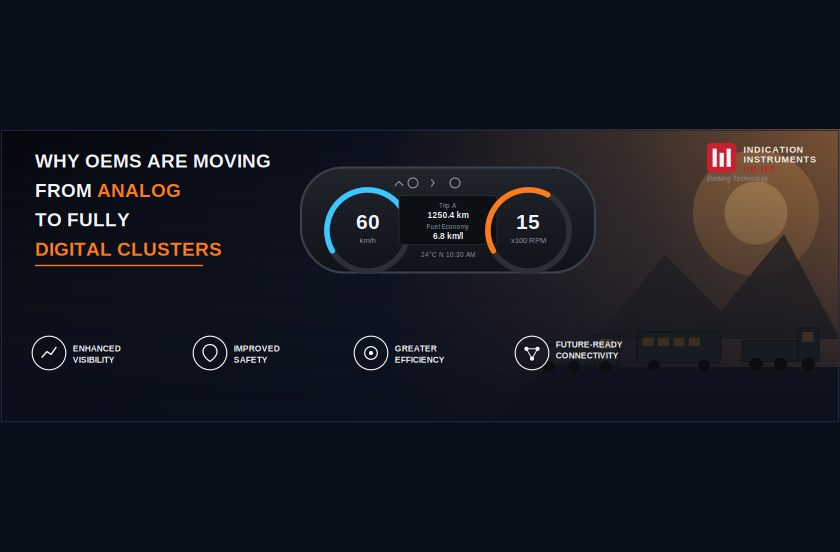
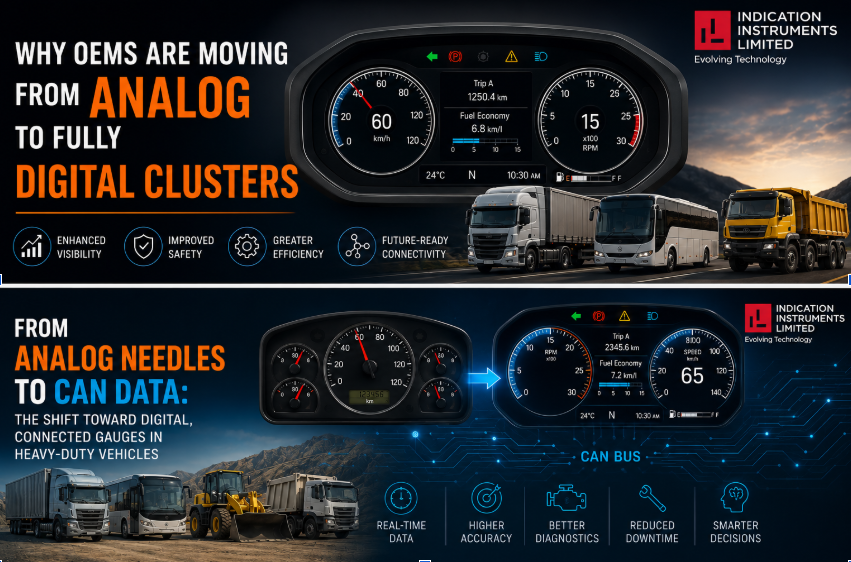
Analog vs Digital Instrument Clusters for Heavy Vehicles: A Practical Guide

Analog vs Digital Instrument Clusters for Heavy Vehicles: A Practical Guide

Analog vs Digital Instrument Clusters for Heavy Vehicles: A Practical Guide

Introduction: An Honest Answer to a Question I Get Asked Regularly

Fleet managers, equipment operators, and procurement teams ask me regularly whether replacing analog instrument clusters with digital units is worth the investment for heavy vehicles. My answer has become more nuanced over the years because the right answer genuinely depends on the application, the fleet size, the operational model, and the existing telematics infrastructure.

What I will not do is give a reflexive answer in either direction. The digital transition in heavy vehicle instrumentation is real, it is accelerating, and in most professional fleet and construction applications the case for digital is strong and quantifiable. But I have also seen programs that specified digital clusters for simple, low-duty-cycle equipment where the additional cost delivered no meaningful operational benefit. Technology selection should follow operational requirements, not vendor enthusiasm.

This post presents an honest assessment of what analog clusters do well, where they fall short in modern fleet operations, what digital clusters add and at what cost, and how to structure the migration decision for existing fleet programs.

The global heavy vehicle instrumentation market is expected to reach USD 8.1 billion by 2027, according to Fortune Business Insights. Within that figure, the share represented by digital display technology has grown from approximately 30 percent in 2018 to an estimated 62 percent in 2024, with continued acceleration expected as telematics integration requirements become standard in commercial fleet procurement.

What Analog Clusters Actually Do Well

I want to start here because the analog cluster’s strengths are real and underappreciated in a market that has a strong commercial incentive to promote digital alternatives.

Mechanical simplicity: A traditional analog cluster has a limited number of components that can fail. The gauge movements are electromechanical. The warning lights are direct-wired. There is no firmware, no software update requirement, and no display processor that can malfunction or require rebooting. For operators who value repairability in remote locations without specialized tooling, this simplicity has genuine operational value.

Instant operator familiarity: Experienced operators who have spent decades reading analog gauges read them accurately and efficiently without conscious effort. The relative position of a needle on a graduated arc is processed peripherally, without the focused attention that reading a numerical value from a digital display requires. For short-duration, frequent-glance parameters like engine speed and road speed, an experienced operator may actually extract information faster from an analog gauge than from a digital readout.

Resilience to software failures: Digital cluster platforms depend on software that can have bugs, require updates, and occasionally fail in ways that produce incorrect displayed values without any hardware fault. An analog gauge that is mechanically and electrically functional will display the correct value. A digital display showing a software-generated incorrect value provides no visible indication that the displayed data is wrong. For safety-critical parameters, this distinction has operational significance.

Lower initial cost in simple applications: For equipment where only 8 to 12 parameters need to be displayed, where telematics integration is not required, and where the operating environment does not stress display electronics, an analog cluster can be a cost-appropriate choice that delivers adequate operational capability without the overhead of a digital platform.

Where Analog Clusters Fall Short in Modern Operations

The strengths of analog clusters are real but bounded. In modern professional fleet and construction operations, several gaps make them increasingly inadequate.

Limited parameter capacity: A typical analog cluster can display 12 to 20 parameters. A modern commercial truck engine ECU monitors more than 200 parameters. Everything the ECU knows about the vehicle’s operational state that the cluster cannot display is invisible to the driver. Fault conditions that do not trigger one of the handful of hard-wired warning lights go unnoticed until they escalate to a major failure.

No fault code display: When a J1939 fault code is generated, an analog cluster’s only response is a generic warning light. The driver knows something is wrong but has no information about what. A digital cluster displays the fault description, severity level, and recommended action. The difference in the driver’s ability to respond appropriately is significant.

No telematics integration: Fleet management platforms need real time data from every vehicle in the fleet. An analog cluster cannot transmit vehicle operating data to a telematics platform. Fleet operators using analog clusters are dependent on manual driver reporting or OBD-II dongle-based aftermarket telematics devices, which provide limited parameter sets and no display feedback to the driver.

Inflexibility as vehicle systems evolve: When an OEM updates the engine management system or adds new emissions monitoring requirements, a digital cluster’s firmware can be updated to display the new parameters. An analog cluster’s fixed gauge set cannot adapt. Fleet operators using analog clusters on older vehicles find themselves with an increasing number of vehicle systems that generate data no one in the cab can see.

What Digital Clusters Add: A Direct Comparison

The table below provides a direct operational comparison between analog and digital instrument cluster implementations in heavy vehicle applications, across the criteria that most directly affect fleet operations.

CriterionAnalog ClusterDigital ClusterBest Suited For
Parameter Capacity12 to 20 fixed parameters60 to 200+ configurable parametersDigital for complex vehicles
Fault Code DisplayGeneric warning light onlyReal time DTC with text descriptionDigital for all fleet applications
Telematics IntegrationNot supported nativelyDirect J1939 TCU integrationDigital for managed fleets
Driver Performance FeedbackNoneLive coaching display and scoresDigital for safety-focused fleets
ADAS Alert RenderingNot supportedFull alert overlay capabilityDigital for modern vehicle platforms
Display ConfigurabilityNone: fixed gauge layoutOperator-configurable zones and parametersDigital for multi-role equipment
OTA ConfigurationNot applicableRemote display configuration updateDigital for large fleets
Software Failure RiskNone (hardware only)Firmware bugs possible, requires managementAnalog for simplest applications
Maintenance and RepairSimple, field-repairableRequires trained technician or unit replacementAnalog for very remote operations
Initial CostLower for basic requirementsHigher initial cost, lower TCO at scaleAnalog for budget-constrained simple programs
Electrification CompatibilityVery limitedFull EV and hybrid parameter supportDigital for electrified fleets

The Migration Case: How to Structure the Decision

For fleet operators considering the migration from analog to digital clusters on an existing fleet, the decision framework I use starts with three questions.

What parameters are you currently not seeing? Audit the gap between what your vehicle ECUs monitor and what your analog clusters display. If that gap contains parameters that would materially affect driver decisions, maintenance scheduling, or fleet compliance, the case for digital is strengthened directly.

What does fleet management platform integration cost you without digital clusters? Calculate the manual data entry effort, aftermarket OBD-II dongle costs, and management overhead associated with operating a fleet without real time telematics integration. The operational cost of the analog baseline is often the most compelling element of the digital ROI calculation.

What is the service life of the vehicles in question? If the vehicles are within three years of scheduled replacement, the investment in digital cluster retrofitting may not recover within the remaining service life. In that case, specifying digital clusters on the replacement vehicles is the cleaner approach. For vehicles with 8 to 15 years of remaining service life, the upgrade economics typically favor retrofit.

Retrofit options range from aftermarket plug-in OBD-II display modules for light applications to full cluster replacement programs with J1939-integrated digital display units. The right scope depends on the vehicle’s network architecture and what level of integration the fleet management platform requires.

For retrofit and new-vehicle digital cluster options for heavy vehicle applications, the product range at Indication Instruments covers a spectrum of capability levels matched to different operational and budget requirements.

When Analog Still Makes Sense

I do not believe every heavy vehicle application should move to digital instrumentation. There are contexts where analog remains appropriate.

Very simple equipment with a small parameter set and no telematics requirement, such as a single-function industrial pump unit or a low-duty-cycle static generator set, does not benefit materially from a digital cluster. The additional cost buys no operational value in these applications.

Environments where display electronics face extreme levels of electromagnetic interference, such as certain high-power welding or induction heating applications, may favor the electromagnetic robustness of simple analog gauge circuits over digital display electronics, though proper EMC design in industrial digital displays addresses most of these concerns in practice.

Legacy vehicle platforms with non-standard sensor outputs that are not CAN-based may require analog displays as the path of least resistance, unless a signal conditioning interface is installed to convert legacy sensor signals to CAN bus messages.

If you are assessing whether digital or analog is the right choice for a specific application, the team at Indication Instruments can provide an objective application assessment.

Frequently Asked Questions


Q1: Can digital instrument clusters replace analog ones without changing the vehicle’s existing wiring?

In most cases, yes with qualifications. If the vehicle has a CAN bus network, a CAN-connected digital display can read vehicle data without replicating the individual sensor wiring of the analog cluster. However, the physical mounting dimensions, connector footprints, and power supply requirements need to be confirmed for each specific vehicle and cluster combination. A direct drop-in replacement is possible in some applications but should not be assumed without verification.

Q2: Are there heavy vehicle applications where analog clusters are still specified as new equipment?

Yes. Some specialized industrial vehicles and construction machines continue to use analog instrumentation where the application is simple, the service environment is extreme in ways that challenge digital electronics, and the operator base has strong familiarity with analog gauge interfaces. These cases are becoming less common as digital platform robustness improves and the telematics integration value proposition becomes more compelling across all commercial vehicle segments.

Q3: How long does it take to train operators on a digital cluster interface after migration from analog?

In a well-designed digital cluster with a clear, logical interface, operators familiar with the equivalent analog cluster typically reach comfortable operation within one to two shifts. The transition is most straightforward when the digital cluster’s default parameter display closely mirrors the layout and parameter set of the analog unit it replaces. Operators who struggle most are those who were expert at reading the subtle nuances of an analog gauge movement and find the transition to discrete digital readout counterintuitive.

Q4: What is the typical ROI timeline for a fleet-wide digital cluster upgrade program?

For large managed fleets, the ROI is typically driven by three factors: fuel savings from real time driver coaching (6 to 12 percent, recovering within 12 to 18 months at typical fleet fuel costs), maintenance cost reduction from earlier fault detection (15 to 30 percent reduction in unplanned maintenance, recovering within 18 to 24 months), and reduced fleet management labor through automated telematics reporting. Combined, these typically produce an ROI within 2 to 3 years for fleets of 50 or more vehicles.

Q5: Do digital clusters require more maintenance than analog ones?

Digital clusters require less mechanical maintenance than analog gauge movements, which have wear components including the needle bearings and stepper motors in electrical analog gauges. Digital clusters require firmware update management, which is a software maintenance task with no equivalent in analog systems. The total maintenance burden is generally lower for digital units in normal operating conditions, but the failure mode, a display electronics fault versus a gauge movement fault, requires different diagnostic skills.

Q6: Where can I compare analog and digital cluster options for my heavy vehicle application?

Indication Instruments offers both traditional and digital instrumentation solutions across a range of heavy vehicle applications. The team can help assess which approach best matches your specific operational requirements and budget.

Related Articles

  1. Digital Gauges vs Mechanical Gauges in Heavy Machinery: A Technical Comparison
  2. Advanced Digital Instrument Clusters for Heavy Duty Trucks and Industrial Vehicles
  3. How Modern Instrument Clusters Improve Driver Awareness and Vehicle Diagnostics
  4. CAN Bus Integration in Digital Displays: How It Improves Vehicle Performance
  5. Rugged Instrument Clusters for Off-Highway Vehicles: Features and Benefits
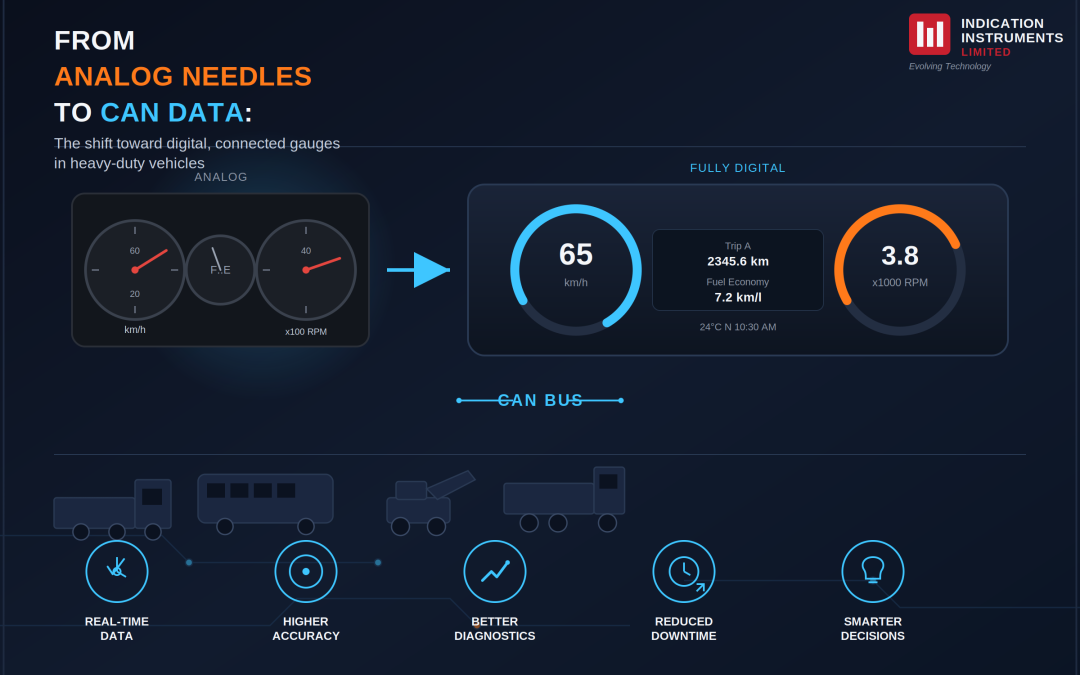
CAN Bus Integration in Digital Displays: How It Improves Vehicle Performance

CAN Bus Integration in Digital Displays: How It Improves Vehicle Performance

CAN Bus Integration in Digital Displays: How It Improves Vehicle Performance

Introduction: CAN Bus Is Not Plug and Play

One of the most persistent misunderstandings I encounter among engineers new to vehicle display integration is the assumption that CAN bus connectivity is straightforward. The protocol is mature, well-documented, and widely supported. The hardware is standardized. Surely connecting a display to a vehicle CAN network is a solved problem.

It is not. The protocol architecture is understood. But getting a digital display to reliably read, interpret, and render vehicle data from a CAN network in a real operating environment involves decisions that significantly affect both the accuracy of the displayed information and the stability of the vehicle’s network behavior. Done well, CAN bus integration transforms what a digital display can do for vehicle performance, driver awareness, and fleet operations. Done poorly, it causes display inaccuracies, network disruption, and integration failures that are difficult to diagnose.

The global automotive CAN bus market is projected to reach USD 3.8 billion by 2026, according to MarketsandMarkets, reflecting the continued dominance of CAN as the primary in-vehicle communication standard across passenger, commercial, and industrial vehicle categories. Understanding what quality CAN bus integration looks like, and what it delivers for vehicle performance and operational visibility, is relevant to anyone specifying display systems for connected vehicle applications.

This post covers the fundamentals of CAN bus architecture as they relate to display integration, the specific performance benefits that CAN-based displays deliver over analog-sensor-wired alternatives, the common integration challenges, and how CAN fits into the broader picture of modern vehicle network architecture.

CAN Bus Fundamentals for Display Integration

CAN (Controller Area Network) was developed by Bosch in the early 1980s and standardized as ISO 11898. Its design was motivated by a need to reduce wiring complexity in vehicles while providing reliable, fault-tolerant communication between distributed electronic control units. Both goals remain as relevant today as they were forty years ago.

Message-based architecture: CAN is not a point-to-point communication system. Every node on the bus can hear every message broadcast by every other node. Each message has an identifier that defines both the message content and its arbitration priority. High-priority messages (with lower identifier values) win arbitration over lower-priority messages when two nodes attempt to transmit simultaneously. This deterministic arbitration behavior makes CAN predictable and real time capable in a way that many later network technologies have struggled to replicate at comparable cost.

High-speed and low-speed networks: CAN operates at data rates up to 1 Mbit/s (high-speed CAN per ISO 11898-2) for powertrain and chassis systems. A fault-tolerant low-speed variant (ISO 11898-3) operates at up to 125 Kbit/s and is used for body electronics where the physical fault tolerance justifies lower performance. Most vehicles run both, connected through gateway ECUs that translate messages between network segments as required.

CAN FD: Controller Area Network with Flexible Data rate is the evolution standard that increases payload size from 8 bytes to 64 bytes and raises maximum data rate to 5 Mbit/s for the data phase. CAN FD is increasingly appearing in premium passenger vehicles and new commercial vehicle platforms where larger payload requirements from ADAS and OTA update use cases exceed the original CAN frame limits. Display hardware specified for new vehicle programs should confirm CAN FD compatibility if the vehicle platform has adopted it.

How CAN Integration Gets Vehicle Data to the Display

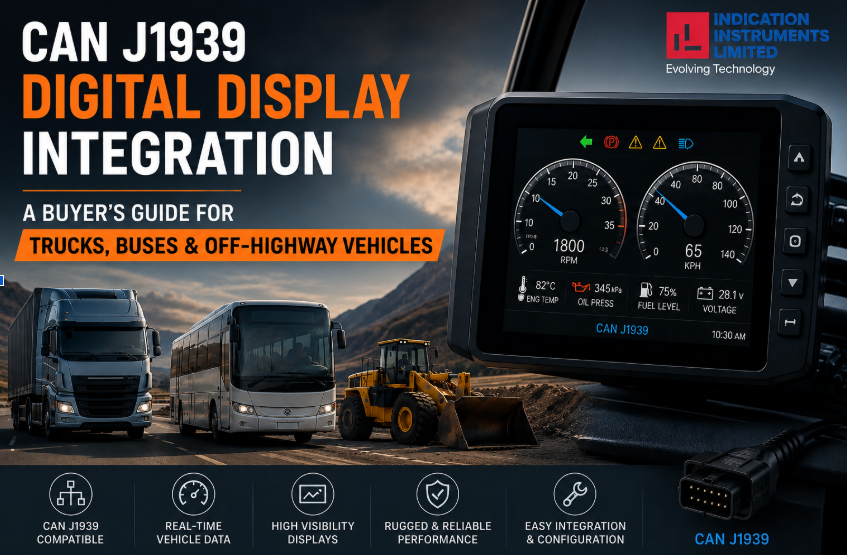
A digital display connected to the CAN bus reads message frames from the bus, maps each frame’s identifier to a known parameter definition (typically a J1939 PGN or OEM-specific identifier), extracts the parameter value from the frame’s data payload per the applicable encoding specification, applies scaling and offset factors to convert the raw value to engineering units, and passes the result to the display rendering engine.

This process happens for every parameter displayed, at the update rate at which each parameter is published on the bus. A display showing 80 parameters simultaneously is parsing and rendering 80 separate CAN data streams. The processing architecture of the display’s system on chip determines whether it can handle that workload without latency or dropped updates.

PGN mapping and configuration: In J1939 applications, each parameter group has a standardized PGN that the display must be configured to recognize. Most industrial display platforms include a default J1939 PGN library. However, OEM-specific proprietary PGNs that carry vehicle-specific parameters not covered by the standard specification require custom configuration. Confirming that the display platform supports custom PGN configuration, not just the standard library, is an important specification check.

Display update rate alignment: Each CAN parameter has an appropriate display refresh rate aligned to its physical behavior. Speed should update at 20ms intervals for smooth analogue-style needle movement. Coolant temperature at 200ms is entirely adequate given the thermal time constants of the system. Aligning display refresh rates to CAN message rates avoids unnecessary processing overhead and prevents visible stepping in continuously varying parameters.

Performance Benefits of CAN-Based Display Integration

The shift from direct-wired analog sensors to CAN-based display integration delivers measurable performance improvements across several dimensions.

Performance DimensionAnalog Sensor WiringCAN Bus IntegrationImprovement
Parameter Count15 to 25 (wire-limited)60 to 200+ parametersUp to 10x more data visible
Measurement AccuracyPlus or minus 3 to 5% typicalPlus or minus 0.5 to 1% (ECU processed)3 to 5x accuracy improvement
Wiring Harness ComplexityIndividual wire per sensor2 wire differential bus, all parametersMajor wiring reduction
Fault Code VisibilityNo fault code display possibleReal time DTC display from J1939Full diagnostic transparency
Sensor Failure DetectionVoltage out of range onlyCAN timeout and message error flagsMore precise fault isolation
OTA ConfigurationNot applicableParameter configuration via CAN messageRemote display configuration possible
Fleet Telematics IntegrationNot supported nativelyDirect TCU integration via shared busFleet visibility enabled
Display Installation EffortHigh: multi-wire harness routingLow: 2 bus wires plus power and groundSignificant installation cost saving
Bus Load ContributionNone1 to 5% typical for display nodeNegligible network impact


Common Integration Challenges and How to Address Them

CAN bus integration in digital displays is a solved engineering problem when approached with the right preparation. The challenges that cause the most field problems are consistently the same ones, and they are consistently avoidable.

Bus termination errors: CAN bus requires a 120-ohm resistive termination at each end of the bus cable. Missing or incorrect termination causes signal reflections that corrupt message frames at high bus utilization. A simple termination resistance check with a multimeter across the bus differential pair (target: 60 ohms for a correctly terminated bus) catches termination errors before they cause field failures.

Message ID conflicts: When a display node is added to an existing CAN network, its messages must not use identifiers already assigned to existing nodes. In J1939 networks, address claiming procedures manage this. In proprietary CAN networks, a bus traffic capture using a CAN analyzer tool before integration reveals the existing ID assignments. Installing a display that conflicts with existing ECU IDs can cause intermittent network errors that are difficult to trace.

CAN bus load management: A display that requests parameter data by transmitting request frames adds to the bus traffic load. A CAN bus running above 70 percent utilization begins to experience message arbitration delays that cause late or missing updates. Specifying a display that listens to broadcast data rather than generating requests, and confirming bus utilization at peak load with a CAN analyzer, prevents load-related display latency in dense ECU environments.

Ground potential differences: CAN differential signaling is robust to common-mode noise, but large ground potential differences between the display and other CAN nodes can push the bus signals outside the receiver’s common-mode input range. Single-point grounding of all CAN bus nodes to a common chassis ground reference eliminates the most common source of this problem in vehicle installations.

For programs where CAN integration reliability is a primary concern, the engineering support team at Indication Instruments has the field integration experience to help identify and resolve common challenges before they reach the production stage.

CAN in the Modern Vehicle Network Architecture

CAN remains the dominant in-vehicle network protocol and will remain so across the majority of commercial and industrial vehicle categories for the foreseeable future. Its combination of robustness, determinism, low cost, and universal ECU support make it difficult to displace in applications that do not require the bandwidth of Automotive Ethernet.

Automotive Ethernet (100BASE-T1 and 1000BASE-T1) is increasingly used in high-bandwidth applications: camera feeds for ADAS, large OTA update file transfers, and high-resolution display video streams. These are the specific use cases where CAN’s bandwidth ceiling becomes a constraint. In the foreseeable future, most commercial and industrial vehicle networks will be hybrid architectures: Automotive Ethernet for high-bandwidth subsystems, CAN for the real time control and sensor communication where its determinism and robustness are most valuable.

Digital displays in these hybrid architectures will need to handle both protocol types. Evaluating candidate display platforms for multi-protocol capability, specifically the ability to parse CAN parameters and render Ethernet-sourced video or data simultaneously, is relevant for vehicle programs targeting 2025 and beyond.

Explore CAN-ready digital display solutions at Indication Instruments for a range of options suited to commercial and industrial vehicle CAN integration requirements.

Frequently Asked Questions


Q1: What is the maximum number of nodes that can be connected to a single CAN bus?

ISO 11898 specifies a theoretical maximum of 32 nodes on a single CAN network segment at full 1 Mbit/s speed. In practice, bus termination and cable impedance characteristics affect the practical maximum. Networks with more nodes are typically segmented using gateway ECUs that bridge between bus segments. A digital display connected as a passive listener (reading broadcast messages without generating requests) contributes minimal load and does not meaningfully constrain the node count on most commercial vehicle networks.

Q2: What is the difference between J1939 PGN configuration and OBD-II PID support?

J1939 PGNs define structured data messages carrying multiple parameters per frame, with standardized message identifiers and data encoding defined by the SAE J1939 specification. OBD-II PIDs are single-parameter diagnostic queries sent to the vehicle’s diagnostic connector and responded to by the relevant ECU. J1939 is the native bus protocol for commercial vehicles. OBD-II is a diagnostic access layer typically used by external devices connecting to the vehicle via the diagnostic port.

Q3: Can a display connected to the CAN bus affect vehicle network performance?

A passively listening display node contributes no transmit load to the bus. A display that actively transmits, for example sending request frames for specific parameters, contributes to bus load. A well-designed display in a J1939 application subscribes to broadcast data rather than generating individual parameter requests, keeping its bus load contribution below 2 percent in typical commercial vehicle networks.

Q4: How does CAN bus integration compare to Modbus for industrial equipment applications?

CAN is the preferred protocol for vehicular applications because of its multi-master broadcast architecture, deterministic message prioritization, and automotive-grade component ecosystem. Modbus is a widely used industrial protocol for stationary machinery and process equipment, operating on RS-485 physical layers. For off-highway vehicles, J1939 over CAN is the appropriate standard. Modbus may appear in some specialized industrial attachments or older telematics equipment but is not a native vehicle communication protocol.

Q5: What tools do I need to validate CAN bus integration for a digital display?

A CAN bus analyzer tool, such as the Peak PCAN-USB or Vector CANalyzer, is essential for capturing and analyzing bus traffic before and after display integration. It allows verification of message ID assignments, bus load measurement, and monitoring of message timing and error rates. For J1939 applications, a J1939-aware analysis tool that decodes PGNs is significantly more useful than a raw frame analyzer.

Q6: Where can I find digital displays with robust CAN bus integration for vehicle applications?

Indication Instruments offers a range of digital display and instrumentation solutions with verified CAN bus integration capability for J1939, CANopen, and OBD-II applications. The team can support both specification and integration validation.

Related Articles

  1. The Importance of Sensor Integration in Modern Vehicle Instrument Clusters
  2. The Role of Instrument Clusters in Connected Vehicle Ecosystems and Telematics Integration
  3. SAE J1939 Protocol Guide: What Fleet Engineers Need to Know
  4. Advanced Digital Instrument Clusters for Heavy Duty Trucks and Industrial Vehicles
  5. How Modern Instrument Clusters Improve Driver Awareness and Vehicle Diagnostics
Rugged Instrument Clusters for Off-Highway Vehicles: Features and Benefits

Rugged Instrument Clusters for Off-Highway Vehicles: Features and Benefits

Rugged Instrument Clusters for Off-Highway Vehicles: Features and Benefits

Introduction: Eight Years in a Quarry

During a site visit to an aggregate quarry in northern England a few years ago, I came across an instrument cluster mounted in a wheel loader that had been running continuously for eight years. Eight years of limestone dust, pressure wash cycles, sub-zero winter starts, and summer cab temperatures that pushed into the high sixties. The cluster was still functioning correctly. The display was slightly dimmer than factory spec on one edge, but all parameters were accurate and no faults had been logged against the display itself in over three years.

I asked the site maintenance manager what they had paid for it versus what they had originally been offered, which was a lower-cost alternative that had been rejected. The rejected unit had failed twice in similar applications at other quarries, both times within 18 months. The cost difference between the two options was approximately 40 percent. The cost of two replacement cycles, including labor, downtime, and logistics, was roughly four times the initial price premium for the rugged unit.

That conversation shaped how I talk about rugged instrument cluster procurement. The discussion should never begin with price. It should begin with the operating environment, the failure consequences, and the total cost of ownership across the equipment’s service life. Only then does price become a meaningful input.

The global off-highway vehicle market encompasses mining, construction, agriculture, forestry, and specialized industrial applications, collectively representing equipment assets valued in the hundreds of billions of dollars globally. The instrument cluster in each of these machines is a critical operational interface. Getting the ruggedness specification wrong is expensive in ways that rarely show up in the initial procurement budget.

What Off-Highway Environments Actually Impose

The term ‘rugged’ is used liberally in product marketing and precisely in engineering specifications. In procurement, the distinction between the two matters considerably.

Temperature extremes: Off-highway equipment operates across a wider temperature range than virtually any other vehicle category. Arctic mining operations in Canada and Russia see ambient temperatures reaching minus 50 degrees C. Equatorial mining and construction sites push cab temperatures above 70 degrees C. Agricultural equipment must cold start at minus 40 degrees C in northern hemisphere spring planting seasons. An instrument cluster rated for minus 40 degrees C to plus 85 degrees C handles this range. One rated for 0 degrees C to plus 70 degrees C does not, and the failure will not be a polite gradual degradation. It will be a sudden cold start failure or a thermal shutdown at a critical operational moment.

Vibration and shock: Off-highway terrain generates vibration profiles that are categorically different from on-road environments. Rock-surface haul roads in mining operations generate random vibration dominated by lower frequencies with high amplitude peaks when the vehicle hits rock irregularities. The shock loads from blade strikes on a motor grader, or from a wheel loader’s bucket hitting the pile, are episodic impulses well outside any road transport vibration specification. A cluster designed to automotive road-surface vibration standards will experience component fatigue failures in these environments within its first year of operation.

Dust and water ingress: Quarrying, earthmoving, and agricultural harvesting operations generate dust concentrations that would be unacceptable in virtually any indoor environment. Combine harvester threshing operations create chaff and grain dust that penetrates every unsealed enclosure. Mining blasting creates airborne particulate that gets into everything. IP-rated sealing on the instrument cluster enclosure, connector bodies, and cable glands is the only reliable protection against dust ingress causing display failures over the equipment lifecycle.

Chemical resistance: Agricultural equipment is exposed to fertilizers, herbicides, and fuel spills. Mining equipment operates in environments with acidic groundwater and processing chemicals. Some forestry machines operate near bark treatment chemicals. The cluster enclosure, cover glass, and connector materials need chemical resistance that standard automotive plastics do not necessarily provide.

The Certification Standards That Define Ruggedness

Certification standards are the mechanism by which ruggedness claims are validated independently of manufacturer marketing. Understanding which standards are relevant to each application is essential for meaningful procurement specification.

MIL-STD-810G: The United States military’s environmental engineering standard defines test methods for temperature, humidity, vibration, shock, altitude, solar radiation, and a range of other environmental stressors. It is widely used as a ruggedness benchmark in industrial applications beyond its original military context. MIL-STD-810G vibration test profiles include specific off-highway vehicle categories that make it the most directly applicable standard for mining and construction equipment displays.

ISO 13766: This standard covers electromagnetic compatibility for earthmoving machinery. It is the most directly relevant EMC standard for construction equipment displays, covering both emissions and immunity to the powerful electromagnetic environments generated by large diesel engines, hydraulic systems with variable speed drives, and radio communication equipment mounted on the same machine.

IEC 60068-2 test series: This series of standards covers environmental testing methods including cold temperature (test Ab), dry heat (test Bb), cyclic humidity (test Db), vibration (test Fc), and mechanical shock (test Ea). Third-party test reports to specific IEC 60068-2 methods provide verifiable ruggedness evidence independent of manufacturer claims.

IP67 and IP69K: IP67 covers temporary immersion in water to 1 meter depth. IP69K covers high-pressure, high-temperature wash-down resistance, the standard for agricultural and construction equipment that undergoes regular cleaning. These are the most commonly specified ingress protection ratings for off-highway instrument clusters.

Ruggedness Requirements by Application Type

Ruggedness requirements are not uniform across off-highway vehicle categories. The table below maps key specification requirements to application type.

SpecificationMiningConstructionAgricultureForestry
Temp RangeMinus 40 to plus 85 CMinus 40 to plus 70 CMinus 40 to plus 70 CMinus 40 to plus 70 C
IP RatingIP67 minimumIP67 minimumIP69K (wash-down)IP67 minimum
Vibration StandardMIL-STD-810G Cat 4ISO 13766 / MIL-STD-810GISO 16750-3 off-highwayMIL-STD-810G
Shock Rating50G per IEC 60068-2-2725G minimum15G minimum25G minimum
Display Brightness2000 nits minimum1500 nits minimum1500 nits minimum1000 nits minimum
MTBF Requirement50,000 hours or greater50,000 hours30,000 to 50,000 hours30,000 hours minimum
Chemical ResistanceAcid and mining chemical ratedFuel and hydraulic oil ratedFertilizer and chemical spray ratedFuel and bark treatment rated
Primary ProtocolJ1939 and CANopenJ1939 and CANopenISOBUS and J1939J1939 and CANopen
EMC StandardISO 13766ISO 13766CISPR 25 off-highwayISO 13766


Design Features That Make Clusters Genuinely Rugged

Ruggedness is a system property, not a single component property. A cluster that uses industrial-grade LCD panels but standard automotive connectors is only as rugged as its connectors. The entire assembly needs to be designed as a cohesive environmental resistance system.

Sealed connector systems: Deutsch DT, Ampseal, and Multilock connector families are widely used in off-highway instrument cluster applications for their positive locking, IP67-rated sealing, and resistance to vibration-induced fretting. Generic automotive connectors without environmental sealing are a common failure point in clusters repackaged for off-highway applications without proper connector specification.

Conformal-coated PCBs: Conformal coating on the cluster’s main PCB protects against humidity condensation, dust contamination, and minor chemical exposure. For mining applications, acrylic coatings provide good general protection. For marine or chemical environments, polyurethane or silicone coatings provide higher resistance to specific chemical classes.

Wide temperature LCD panels: Standard TFT panels have reduced contrast and slower pixel response times at temperatures below minus 10 degrees C. Industrial-grade wide temperature LCD panels maintain specified contrast and response times across the full minus 40 to plus 85 degree C operating range. The performance difference at cold start is visually significant and operationally important for operators who need full display readability immediately after starting a machine in winter conditions.

The rugged display and instrument cluster range at Indication Instruments is built around these industrial design principles, with environmental certification evidence available for all claimed ratings.

Total Cost of Ownership: The Argument for Genuine Ruggedness

The price premium for a properly specified rugged cluster over a consumer-grade alternative is typically 30 to 60 percent at initial procurement. Over the service life of the equipment, this premium is almost always recovered through avoided failures, and in many applications the rugged option proves materially cheaper in total cost terms.

Consider a mining haul truck operating 6,000 hours per year, 320 days per year. An instrument cluster with a 50,000-hour MTBF has a statistical mean failure interval of 8.3 years in that application. A consumer-grade cluster with a 20,000-hour MTBF has a statistical mean failure interval of 3.3 years. Over an 8-year equipment life, the consumer-grade option requires an average of 2.4 failure-related replacements, each involving diagnostic labor, parts cost, and equipment downtime during an unplanned maintenance event.

In a mining environment, unplanned equipment downtime costs have been benchmarked at USD 10,000 to USD 20,000 per hour depending on the machine type and mine operational model. Even a two-hour downtime event for cluster replacement, at the low end of that range, represents USD 20,000 in lost production value. The cost differential between a rugged and a consumer-grade cluster frequently falls below the cost of a single avoidable downtime event.

Contact the Indication Instruments team to discuss total cost of ownership analysis for your specific off-highway vehicle application.

Frequently Asked Questions


Q1: What is the most important ruggedness specification for agricultural equipment instrument clusters?

IP69K ingress protection is typically the most critical specification for agricultural equipment, given the regular pressure washing that tractors, harvesters, and self-propelled sprayers undergo. A cluster rated IP67 but not IP69K may survive field dust and rain exposure but fail when subjected to the high-pressure, high-temperature cleaning typical of post-harvest washdown procedures.

Q2: What does MIL-STD-810G certification actually require?

MIL-STD-810G is a test methodology standard, not a single pass/fail certification. A product claiming MIL-STD-810G compliance has been tested to one or more of its test methods, which cover specific environmental stressors. The important question is which specific test methods were applied, what test profiles were used (there are application-specific profiles for different vehicle categories), and whether testing was conducted by an independent third-party laboratory.

Q3: Can standard automotive instrument clusters be upgraded to meet off-highway ruggedness requirements?

In most cases, no. The fundamental environmental limitations of standard automotive clusters come from component choices, connector specifications, and enclosure design decisions made at the product architecture level. Conformal coating can be added retrospectively, but wide-temperature LCD panels, sealed connector systems, and shock-mounted display assemblies require a purpose-built design. Retrofitting consumer-grade clusters for off-highway use typically produces a product with marginally improved ruggedness at significantly higher total cost than specifying a purpose-built rugged unit.

Q4: How do I verify that an IP69K rating is genuine rather than a specification claim?

Request the third-party test report from an accredited test laboratory per IEC 60529, which defines the IP rating test methodology. IP69K testing involves a high-pressure water jet at 80 degrees C, 80 to 100 bar pressure, at a distance of 100 to 150mm, from multiple angles. The test report should document the specific test parameters, the sample tested, and the test laboratory accreditation. Manufacturer self-certification without independent test evidence is insufficient for specification critical applications.

Q5: What operating temperature range should I specify for a mining application in northern Canada?

Minus 40 degrees C to plus 85 degrees C is the appropriate specification for northern Canadian mining applications. The minus 40 degrees C cold start requirement ensures display function during cold starts in winter conditions. The plus 85 degrees C upper limit accounts for engine bay radiant heat and solar gain in cab environments during summer operations. Requesting confirmed cold start performance, meaning the display initializes and shows correct data within a defined period at minus 40 degrees C, is an important additional specification beyond the operating range claim.

Q6: Where can I source genuinely rugged instrument clusters for off-highway vehicle applications?

Indication Instruments supplies rugged display and instrumentation solutions with verified environmental certifications for mining, construction, agricultural, and forestry applications. The team can provide third-party test evidence for IP ratings, vibration certifications, and operating temperature performance.

Related Articles

  1. Advanced Digital Instrument Clusters for Heavy Duty Trucks and Industrial Vehicles
  2. Multi-Function Digital Displays for Construction and Agricultural Equipment
  3. IP67 vs. IP69K: Choosing the Right Ingress Protection Rating for Your Application
  4. CAN Bus Integration in Digital Displays: How It Improves Vehicle Performance
  5. How Predictive Maintenance Is Reducing Equipment Downtime in Mining Operations
The Importance of Sensor Integration in Modern Vehicle Instrument Clusters

The Importance of Sensor Integration in Modern Vehicle Instrument Clusters

The Importance of Sensor Integration in Modern Vehicle Instrument Clusters

Introduction: Four Sensors Every Cluster Must Get Right

I want to start with something that happened on a test drive a few years back. We were validating a new instrument cluster integration on a commercial truck platform and everything looked fine in the workshop. All parameters reading correctly, CAN traffic healthy, no DTCs. We pulled the truck out onto a test road, ran it through its warm-up cycle, and the fuel level gauge read 78 percent full when the tank was actually at 91 percent. Nobody had caught it during bench testing because the fuel level sender only starts behaving differently once the truck is moving and the fuel is sloshing.

That experience reinforced something I now repeat to every engineer joining our team: sensor integration is not finished when the display shows a number. It is finished when the display shows the right number, at the right time, under the actual operating conditions of the vehicle. That distinction matters enormously in field applications.

The global vehicle sensor market is projected to reach USD 47.2 billion by 2027, according to Allied Market Research, driven by ADAS proliferation, electrification, and connected vehicle telematics requirements. Modern instrument clusters sit at the convergence point of all this sensor data. Among the many sensor types that feed into a cluster, four are foundational to commercial and industrial vehicle operation: fuel level sensors, pressure sensors, speed sensors, and temperature sensors.

This post goes deep on each of those four, covering the sensor technology, the integration architecture, the calibration requirements, and the display accuracy considerations that determine whether the cluster is genuinely useful or just superficially impressive.

Fuel Level Sensors: More Complex Than a Float on a Wire

Fuel level measurement sounds like one of the simpler problems in vehicle instrumentation. You have a tank. You want to know how full it is. In practice, it is one of the most consistently problematic sensor integrations I have encountered across dozens of vehicle programs.

How Fuel Level Sensors Work

The majority of commercial vehicles still use resistive float sender units as their primary fuel level measurement technology. A float arm pivots as the fuel level changes, moving a wiper across a resistive track. The resistance value, typically ranging from 10 ohms full to 180 ohms empty in common sender configurations, is read by the ECU and converted to a percentage or volumetric reading.

More sophisticated applications use capacitive or ultrasonic level sensors. Capacitive sensors measure the dielectric change between two electrodes submerged in the fuel tank, which varies with fuel level. They are less susceptible to fuel sloshing and mechanical wear, and they work correctly in non-standard tank geometries where a float arm would bind or give a non-linear reading. Ultrasonic sensors measure the time of flight of an ultrasonic pulse from the sensor head to the fuel surface and back, giving a level reading independent of the fuel’s electrical properties.

Integration and Display Accuracy Challenges

The non-linearity problem is the most common source of fuel level display errors. Most fuel tanks are not cylindrical. They are shaped around chassis, suspension, and body constraints. A tank that is 75 percent full by volume may only be 60 percent full by depth, because the tank cross-section changes with height. Accurate fuel level display requires a tank-specific calibration lookup table in the ECU that maps sender resistance to actual volume. Generic, uncalibrated integrations routinely show errors of 10 to 15 percent at mid-tank levels.

Fuel sloshing during acceleration, braking, and cornering creates transient sensor readings that, if displayed directly, produce a gauge that visibly oscillates during normal driving. Proper integration applies a damping algorithm, typically a rolling average or a low-pass filter with a time constant matched to the vehicle’s operational dynamics, before the value reaches the display. The filter needs to be tuned specifically for the vehicle type: a long-haul truck on motorway grades needs different damping than a short-wheelbase agricultural vehicle on hilly terrain.

Indication Instruments’ fuel level display solutions: View panel meters and display products that support configurable calibration tables for non-linear tank geometries and adjustable signal damping parameters for accurate fuel level display across vehicle types.

Pressure Sensors: Safety-Critical Measurement from Oil to Hydraulics

Pressure is one of the most safety-critical parameters in commercial and industrial vehicles. Engine oil pressure, hydraulic system pressure, transmission oil pressure, air brake reservoir pressure, fuel rail pressure, and coolant pressure are all monitored by sensors whose readings directly influence safety-critical decisions, whether automated by the vehicle’s control systems or made by the operator based on what they see on the cluster display.

Sensor Technology: Piezoresistive Transducers

The dominant technology for vehicle pressure measurement is the piezoresistive pressure transducer. A silicon or metal diaphragm deflects under applied pressure, and the strain changes the resistance of piezoresistive elements diffused into or bonded to the diaphragm surface. The resistance change produces a millivolt output that is amplified and conditioned to a standard signal range, typically 0.5 to 4.5 volts for ratiometric sensors, or converted to a 4 to 20 milliamp current loop output for industrial applications.

Modern pressure sensors integrate signal conditioning, temperature compensation, and analog-to-digital conversion on-chip, outputting a digital value directly via I2C, SPI, or CAN. For heavy vehicle applications, sensors with integrated CAN output publish pressure data directly onto the vehicle bus, eliminating the separate signal conditioning chain and reducing integration complexity.

Absolute, Gauge, and Differential Pressure

These distinctions matter for integration and display accuracy. Absolute pressure sensors reference to a perfect vacuum. Gauge pressure sensors reference to ambient atmospheric pressure and are the standard for most vehicle fluid pressure measurements, since the operator needs to know pressure above or below atmospheric, not above vacuum. Differential pressure sensors measure the pressure difference between two points, relevant for applications like air filter restriction monitoring where the pressure drop across the filter indicates contamination level.

Specifying the wrong pressure reference in a sensor integration is a surprisingly common error. An absolute pressure sensor in an oil pressure monitoring application will show a reading approximately 1 bar higher than the actual gauge pressure at sea level, and that offset shifts with altitude for high-elevation operation. For a sensor with a full-scale range of 0 to 10 bar, a 1 bar offset from incorrect sensor type selection is a 10 percent constant error across the operating range.

Display Accuracy and Warning Threshold Calibration

Pressure warning thresholds in commercial vehicles are often defined by regulatory standards or OEM specification. SAE J1939 PGN 65263 (Engine Fluid Level and Pressure) carries engine oil pressure with a resolution of 4 kPa per bit. The instrument cluster must apply the correct scaling factor and offset to convert the raw 8-bit or 16-bit CAN value to a displayed engineering unit. An incorrect scaling factor in the display configuration produces a systematic display error across the full pressure range, which may not be obvious during commissioning if the displayed value looks plausible.

For hydraulic pressure monitoring in industrial and off-highway vehicles, see the range of panel meters at Indication Instruments engineered for the accuracy and update rate requirements of safety-critical pressure display applications.

Speed Sensors: Tachometers, Speedometers, and What Lies Between

Speed sensing in modern commercial and industrial vehicles covers multiple distinct measurements: vehicle road speed, engine RPM, transmission output shaft speed, wheel speed at individual corners for ABS and stability control, and PTO shaft speed for powered implements. Each has its own sensor technology, update rate requirement, and display accuracy specification.

Hall Effect and Variable Reluctance Sensors

The two dominant technologies for vehicle speed sensing are Hall effect sensors and variable reluctance (VR) sensors, sometimes called inductive sensors. Both work by detecting the passage of ferromagnetic teeth on a toothed ring or reluctor wheel attached to the rotating shaft.

A variable reluctance sensor generates a sinusoidal AC voltage as each tooth passes, with amplitude proportional to the rate of tooth passage. At low speeds the signal amplitude drops, which creates a minimum speed threshold below which the sensor output becomes unreliable. VR sensors have no active electronics and are inherently robust to temperature and vibration, making them a common choice for transmission speed sensing in heavy vehicles.

Hall effect sensors use a magnetic field and semiconductor switching element to generate a clean digital pulse output regardless of speed. The digital output makes signal conditioning simpler and allows accurate speed measurement all the way down to very low shaft speeds, including standstill detection for some configurations. Modern Hall effect sensors with integrated signal conditioning provide a direct digital pulse train output suitable for direct connection to an ECU’s input capture peripheral or a display’s frequency measurement input.

Pulse Counting, Frequency Conversion, and Display Accuracy

Vehicle speed calculation from a pulse-based sensor involves counting pulses over a defined measurement interval, or measuring the interval between successive pulses, and converting the result to velocity using the known tooth count and wheel circumference or shaft gear ratio. The accuracy of the displayed speed depends on the precision of those constants. A tyre wear-related reduction in rolling radius of 5 percent produces a vehicle speed display error of 5 percent if the wheel circumference constant is not updated.

For speedometer applications in commercial vehicles, European type approval and similar regulatory frameworks specify maximum permissible speed display errors, typically plus 10 percent and minus 0 percent, meaning the displayed speed must never be lower than actual speed by any amount. Instrument cluster display software for speed must implement the correct bounds checking and calibration factor application to remain within regulatory limits.

Engine RPM display from crankshaft position sensor data via J1939 PGN 61444 (Electronic Engine Controller 1) requires a display update rate of at least 100ms to avoid visible stepping on the tachometer at normal engine speed ranges. For tachometers that also need to display peak RPM and over-rev events, the capture rate needs to be fast enough to catch transient peaks that may only persist for one or two engine revolutions.

Indication Instruments offers digital displays and instrument clusters with configurable tachometer and speedometer display parameters suited to the pulse input and CAN data requirements of commercial vehicle speed measurement.

Temperature Sensors: From Coolant to Exhaust, One Sensor Type Does Not Fit All

Temperature is the most ubiquitous measurement in vehicle instrumentation. Coolant temperature, engine oil temperature, transmission oil temperature, exhaust gas temperature, ambient air temperature, turbocharger air charge temperature, fuel temperature, and in electrified vehicles, battery cell temperature and motor winding temperature. Each application has specific temperature range, accuracy, and response time requirements that influence the sensor technology selection and integration approach.

NTC Thermistors: The Workhorse of Vehicle Temperature Sensing

Negative temperature coefficient (NTC) thermistors are the dominant temperature sensor type in most vehicle powertrain and fluid temperature applications. Resistance decreases non-linearly as temperature increases. A typical coolant temperature NTC might have a resistance of 2.5 kilohms at 25 degrees C, dropping to approximately 200 ohms at 100 degrees C. The non-linear resistance-temperature characteristic means the ECU must apply a Steinhart-Hart equation or a lookup table to convert the measured resistance to a temperature value.

The advantage of NTC thermistors is low cost, small package size, fast thermal response due to small thermal mass, and robust performance across the temperature ranges typical of coolant and oil temperature applications. The disadvantage is that each sensor type has a unique characteristic curve, so the ECU calibration must be matched to the specific sensor part number. Substituting a sensor from a different manufacturer without updating the calibration table produces a display error that may appear small at one operating point and large at another, because the curves diverge non-uniformly.

RTDs and Thermocouples for High-Temperature Applications

For exhaust gas temperature measurement, NTC thermistors are not suitable. Diesel engine exhaust temperatures range from approximately 200 degrees C at idle to 700 degrees C or above under high load, and up to 900 degrees C in some turbocharged applications at the turbine inlet. These temperatures exceed the operating range of standard NTC thermistors.

Type K thermocouples are the standard technology for exhaust gas temperature measurement. A thermocouple generates a millivolt potential proportional to the temperature difference between its measuring junction (in the exhaust flow) and a cold junction reference (at the measurement electronics). Type K thermocouples have a sensitivity of approximately 41 microvolts per degree C and operate up to around 1200 degrees C. The cold junction compensation requirement adds complexity to the signal conditioning design.

Platinum resistance temperature detectors (PT100 and PT1000 RTDs) are used in applications requiring higher accuracy and linear output over a wide temperature range. Transmission oil temperature monitoring, where accurate temperature tracking affects shift scheduling decisions in an automatic transmission control unit, is a common RTD application. PT100 sensors have a resistance of 100 ohms at 0 degrees C and increase linearly at approximately 0.385 ohms per degree C, making them simple to interface and calibrate with high accuracy.

What the Instrument Cluster Needs to Display Correctly

The instrument cluster receives temperature data as corrected engineering unit values via J1939 CAN messages in most modern commercial vehicle architectures. Engine coolant temperature is carried on PGN 65262 with a resolution of 0.03125 degrees C per bit and an offset of minus 273 degrees C, covering a range from cryogenic to high-temperature operation. Transmission oil temperature is on PGN 65272. Exhaust temperature parameters are carried on specific EGT PGNs depending on the exhaust system configuration.

A common display integration error for temperature parameters is applying the wrong offset. J1939 temperature parameters carry a significant negative offset in the raw CAN value to cover sub-zero temperatures. If the display software applies the scaling factor without the offset, displayed temperatures will appear 200 to 273 degrees lower than actual at ambient conditions, producing an obvious error at startup. Less obvious is when the offset is partially applied, producing a systematic error of 20 to 50 degrees that might not be caught if commissioning validation only checks values at operating temperature rather than across the full range from cold start to full operating temperature.

View the full range of temperature display and monitoring products at Indication Instruments engineered for the accuracy and operating range requirements of commercial and industrial vehicle temperature measurement applications.

Sensor Integration Specifications: A Comparison of All Four Types

The table below summarizes the key integration specifications for fuel level, pressure, speed, and temperature sensors in commercial vehicle instrument cluster applications.

SpecificationFuel LevelPressureSpeedTemperature
Primary Sensor TechnologyResistive float sender or capacitivePiezoresistive transducerHall effect or VR pulse sensorNTC thermistor, RTD, thermocouple
Signal TypeAnalog resistance or CANAnalog voltage (0.5 to 4.5 V), 4 to 20 mA, or CANFrequency pulse train or CANAnalog resistance or CAN via ECU
Typical Update Rate (CAN)500ms to 2 seconds100 to 200ms20 to 100ms200 to 500ms
Primary J1939 PGNPGN 65276 (Dash Display)PGN 65263 (Engine Fluid Level and Pressure)PGN 61444 (EEC1), PGN 65265PGN 65262 (Engine Temp), 65272 (Trans)
Key Calibration RequirementNon-linear tank geometry table and sloshing filterCorrect pressure reference type and scaling factorPulse count per revolution and wheel circumferenceSensor-specific Steinhart-Hart curve or lookup table
Accuracy SpecificationPlus or minus 3 to 5 percent of full scalePlus or minus 1 to 2 percent of full scalePlus or minus 1 percent of readingPlus or minus 1 to 2 degrees C (NTC/RTD)
Typical Temperature RangeMinus 40 to plus 85 CMinus 40 to plus 125 CMinus 40 to plus 125 CMinus 40 to plus 150 C (up to 1200 C EGT)
Common Display Failure ModeSlosh oscillation or non-linear errorWrong reference type or scaling errorStepping at low speed, peak capture missOffset error from incorrect J1939 decoding

How the CAN Bus Connects All Four Sensor Types to the Cluster

Every one of the four sensor types described above reaches the instrument cluster via the J1939 CAN bus in a modern commercial vehicle architecture. The bus is the integration backbone, and its behavior directly affects the quality of what the display shows.

Each sensor’s data arrives as a structured CAN frame, identified by a parameter group number (PGN), with a data payload encoded per the J1939 SPN specification for that parameter. The instrument cluster’s CAN controller receives the frames, applies the PGN lookup to identify each parameter, decodes the raw value using the specified resolution and offset, and passes the engineering unit value to the display rendering logic.

Bus health directly affects display accuracy. A CAN bus running above 70 percent utilization experiences message arbitration delays that can cause displayed parameter values to lag behind actual sensor readings. For a temperature or pressure display, a few hundred milliseconds of lag is acceptable. For a speed display used for speedometer output or for displaying wheel speed during ABS activation, even 50ms of lag is operationally significant.

Message timeout handling is the specific integration behavior that separates well-designed clusters from problematic ones. When a fuel level sender fails, or a speed sensor ECU drops off the bus, the cluster must detect the timeout, display a defined fault state for the affected parameter, and log a DTC. Continuing to display the last valid value as though the sensor is still functional is a safety issue in pressure and temperature monitoring applications.

The panel meters and digital displays from Indication Instruments are engineered with the CAN protocol depth, PGN configuration flexibility, and message timeout handling that these four critical sensor types require.

Frequently Asked Questions

Q1: Why does a fuel level gauge often read incorrectly at partial tank levels?

Most fuel tanks have a non-cylindrical shape that changes cross-section at different heights, meaning depth and volume are not proportional. Accurate fuel level display requires a tank-specific calibration table that maps float sender resistance to actual tank volume. Generic calibration without a tank-specific table routinely produces errors of 10 to 15 percent at mid-tank levels. Additionally, vehicle motion causes fuel sloshing that creates transient resistance variations, which must be filtered with a damping algorithm tuned to the vehicle’s dynamics.

Q2: What is the difference between gauge pressure and absolute pressure sensors, and why does it matter for display accuracy?

Gauge pressure sensors reference to ambient atmospheric pressure, which is the standard for most vehicle fluid pressure monitoring (oil pressure, hydraulic pressure, air pressure). Absolute pressure sensors reference to a perfect vacuum. Using an absolute pressure sensor where a gauge pressure sensor is specified results in a displayed pressure reading approximately 1 bar higher than actual at sea level, with additional variation at altitude. This is a systematic calibration error that appears reasonable during bench testing but produces incorrect warnings in field operation.

Q3: What causes stepping or jumping behavior on a digital speedometer display?

Speedometer stepping occurs when the speed sensor pulse update rate or the CAN message publication rate is slower than the display refresh rate, causing the displayed value to update in discrete jumps rather than smoothly. At 20 mph with a 12-tooth reluctor wheel, the pulse interval is approximately 28ms. If the display samples the CAN speed message at 100ms intervals and the message is only published at 100ms, there is a visible two-digit jump every update cycle. Solutions include increasing the CAN message publication rate, using pulse-period averaging in the ECU before publishing, or applying display-side smoothing algorithms.

Q4: What temperature sensor type should be specified for exhaust gas temperature monitoring?

Type K thermocouples are the standard for exhaust gas temperature measurement in diesel and gasoline engines, covering the operating range from approximately 0 degrees C to 1200 degrees C. They require cold junction compensation at the measurement electronics and have a non-linear output that needs to be characterized over the operating range. For applications below 500 degrees C where higher accuracy is needed, such as charge air temperature monitoring, PT100 or PT1000 RTDs provide better linearity and repeatability than NTC thermistors.

Q5: How should an instrument cluster handle a situation where a pressure sensor signal is lost?

A correctly implemented cluster monitors the CAN message timeout interval for each pressure parameter. If the oil pressure message from the engine ECU stops arriving within the expected interval, the cluster should immediately transition the oil pressure display to a defined fault state, typically a symbol and ‘Sensor Fault’ message, generate a DTC for the communication fault, and trigger a caution-level alert to the driver. Continuing to display the last valid pressure value after a sensor communication fault is a safety issue, because the driver may be relying on that reading to assess whether to continue operating the vehicle.

Q6: Where can I find display and panel meter solutions suited to fuel level, pressure, speed, and temperature monitoring?

Indication Instruments offers a range of panel meters, digital displays, and instrument cluster solutions engineered for the CAN integration depth, calibration flexibility, and environmental tolerance that commercial vehicle sensor monitoring applications require. The product range covers both J1939 CAN-connected displays and direct analog sensor input meters for the fuel level, pressure, speed, and temperature parameters covered in this post.

Related Articles

  1. CAN Bus Integration in Digital Displays: How It Improves Vehicle Performance
  2. How Modern Instrument Clusters Improve Driver Awareness and Vehicle Diagnostics
  3. The Role of Instrument Clusters in Connected Vehicle Ecosystems and Telematics Integration
  4. Advanced Digital Instrument Clusters for Heavy Duty Trucks and Industrial Vehicles
  5. Digital Gauges vs Mechanical Gauges in Heavy Machinery: A Technical Comparison

The Role of Instrument Clusters in Connected Vehicle Ecosystems and Telematics Integration

The Role of Instrument Clusters in Connected Vehicle Ecosystems and Telematics Integration

The Role of Instrument Clusters in Connected Vehicle Ecosystems and Telematics Integration

Introduction: When the Dashboard Became a Network Node

Years ago, when I first worked with embedded display systems for automotive applications, the instrument cluster was treated as a relatively peripheral component. It showed the driver what they needed to see, speed, fuel level, temperature, RPM, and that was essentially the full extent of its job. There was no architecture discussion, no integration planning, no protocol matrix. You wired it up, calibrated the gauges, and moved on to the next thing.

That world no longer exists. And if I am honest, I think a significant portion of the industry is still catching up to just how much the role of the instrument cluster has changed.

Today, the modern instrument cluster sits at the intersection of sensor networks, embedded processing, cloud platforms, and telematics infrastructure. It is not simply a display. It is an active network node, processing data from dozens of vehicle systems in real time while simultaneously participating in a continuous two-way flow of information that extends well beyond the vehicle itself.

The global connected car market is projected to exceed USD 166 billion by 2025, according to Allied Market Research. The broader vehicle telematics segment is expected to reach USD 107 billion by 2028. These are not incremental numbers. They represent a structural shift in how vehicles are designed, operated, and managed at scale.

This post walks through the actual architecture of instrument cluster and telematics integration, the communication protocols that make it function, the measurable business outcomes it drives in fleet operations, and where the technology is headed over the next few years.

What Modern Instrument Clusters Actually Do

The first thing I tell engineers new to this problem space is this: a connected instrument cluster is not a passive screen. It is an active ECU (Electronic Control Unit) node. That distinction matters a great deal when you start designing telematics integration.

At the hardware level, a connected cluster runs on an automotive grade system on chip, processing inputs from the vehicle’s CAN bus network, applying rendering logic, and outputting to a high resolution TFT or OLED display. The SoC also handles communication with the telematics control unit, manages ADAS overlay data, and in more advanced implementations supports bidirectional communication with remote fleet management platforms.

The market reflects this functional expansion. The global digital instrument cluster market is projected to reach USD 10.9 billion by 2028, according to Markets and Markets, growing at a CAGR of 6.8 percent from 2023. That growth is not primarily about aesthetics, though the visual transformation has been dramatic. It is driven by the functional requirements that connected vehicle programs impose on cluster hardware and software.

In practical terms, three shifts define the modern cluster’s expanded role. First, clusters now receive and process ADAS data in real time, rendering lane departure alerts, forward collision warnings, and blind spot indicators directly on the primary display. Second, they act as HMI hubs that bridge the driver and the vehicle’s underlying ECU network, surfacing information from dozens of subsystems through a single, coherent interface. Third, and most relevant for telematics integration, they function as data gateway interfaces that actively exchange information with the telematics control unit (TCU) mounted elsewhere in the vehicle.

I have seen deployments where engineering teams treated the instrument cluster as an output-only device well into the architecture phase, then struggled to retrofit bidirectional capability. The time to plan for telematics integration is at the hardware selection stage, not after. When reviewing digital display and cluster solutions for any connected vehicle program, protocol support and communication architecture should be the first evaluation criteria on the list, not the last.

Telematics Integration Architecture: How the Layers Fit Together

Telematics integration in a connected vehicle follows a layered architecture. Understanding each layer is essential before committing to hardware or software choices.

The Vehicle Layer: CAN Bus and Beyond

The CAN (Controller Area Network) bus remains the primary communication backbone for in-vehicle networking. Developed by Bosch in the 1980s, CAN allows multiple ECUs to communicate over a shared bus without a host computer, with data frames transmitted at speeds of up to 1 Mbit/s on high speed networks. Most modern vehicles run multiple CAN segments: a high speed network for powertrain and chassis systems and a lower speed network for body electronics.

The instrument cluster reads from this bus continuously. Messages from the engine control module, transmission, braking systems, and chassis sensors arrive as structured CAN frames that the cluster decodes and renders visually. The cluster itself also generates messages, broadcasting display status and user input events back onto the bus.

The Telematics Layer: TCU and Data Transmission

The telematics control unit sits on the same CAN bus and reads the same message traffic. It applies filtering logic to extract relevant parameters, aggregates them into structured packets, and transmits them over a cellular connection (typically LTE Category 1 or Category 4) to the fleet management backend. In basic architectures, this is one directional. The vehicle sends data. Nothing comes back to the cluster display.

In advanced implementations, the TCU and cluster share a dedicated communication channel. The fleet management platform can push driver performance data, routing updates, or operational alerts back through the TCU to the cluster display. This bidirectional model is more complex to implement but dramatically expands what telematics actually delivers to operators.

The Cloud Layer: Platform and Analytics

The cloud backend receives data streams from connected vehicles, applies analytics and machine learning models, and surfaces insights through a fleet management dashboard. Predictive maintenance alerts triggered by anomalous sensor patterns, fuel efficiency benchmarks comparing driver behavior across the fleet, and compliance reports for regulatory requirements all originate at this layer before being pushed back through the TCU to the cluster display.

According to McKinsey, the shift to over the air (OTA) updates enabled by this architecture is expected to reduce vehicle service costs by up to 35 percent over the vehicle lifetime. For fleet operators managing hundreds of vehicles, the compound efficiency is substantial. The instrumentation solutions at Indication Instruments are specifically engineered for the high reliability, real time communication demands that this kind of connected vehicle architecture requires.

Traditional vs. Connected Instrument Clusters: A Feature Comparison

The table below summarizes the key functional differences between a traditional instrument cluster and a connected cluster with full telematics integration. These distinctions directly affect procurement decisions, integration complexity, and the operational value delivered across a fleet program.

FeatureTraditional Instrument ClusterConnected Cluster with Telematics
Data CommunicationOne-way local display only. No outbound data path.Bidirectional communication with TCU and cloud fleet platform.
Protocol SupportAnalog sensor inputs or basic CAN reading.CAN, LIN, Ethernet, OBD-II, J1939 depending on vehicle class.
Remote DiagnosticsNot available. Manual inspection required.Real time fault code transmission to fleet management backend.
Over the Air UpdatesNo OTA capability. Physical servicing required.Firmware and configuration updates pushed over cellular channel.
Driver Performance FeedbackStatic gauges only. No scored metrics displayed.Live performance scoring calculated from cloud analytics and rendered on cluster.
ADAS IntegrationLimited or none. No sensor fusion overlay.Full sensor fusion overlays including lane alerts, collision warnings, and blind spot indicators.
Fleet VisibilityZero. No remote visibility for fleet operators.Live GPS position, speed, health status, and driver behavior per vehicle.
Data LatencyNot applicable. No external data path.CAN read under 100ms. Cloud push latency typically under 2 seconds.
Predictive MaintenanceOdometer or time based service intervals only.Sensor driven alerts surfaced on cluster display from predictive backend models.
Cybersecurity RequirementsNot applicable. Isolated system.Secure boot, firmware signing, encrypted communication, and access controls required.


Communication Protocols: What Powers the Connection

The protocol layer is where most telematics integration projects encounter real complexity. I have seen programs that looked straightforward on paper stall for months because the protocol compatibility between the cluster hardware, the TCU, and the cloud backend was not properly specified from the start.

CAN and OBD-II: The Universal Foundation

CAN is the foundational in-vehicle protocol. Its deterministic behavior and fault-tolerant design make it well suited for real time sensor communication in safety-critical systems. OBD-II provides a standardized diagnostic interface layer on top of CAN, enabling external devices to query vehicle parameters using standard PIDs (Parameter IDs). Standardized in the United States since 1996, OBD-II is the connection point for the vast majority of aftermarket telematics devices in passenger and light commercial vehicle deployments.

SAE J1939: The Commercial Fleet Standard

SAE J1939 extends CAN for commercial and heavy duty vehicle applications using a more sophisticated parameter group numbering (PGN) system. It supports granular tracking of metrics specific to trucking, construction, and transit applications, including engine torque, exhaust temperature, axle load distribution, and hundreds of other parameters not available through standard OBD-II. For any deployment involving commercial fleets, J1939 fluency is absolutely essential. It is not optional.

LIN, MOST, and Automotive Ethernet

LIN (Local Interconnect Network) handles lower bandwidth peripheral tasks within the vehicle, such as seat position sensors and mirror controls. MOST (Media Oriented Systems Transport) is used in premium vehicles for high bandwidth multimedia data. Automotive Ethernet, specifically the 100BASE-T1 and 1000BASE-T1 standards, is rapidly becoming the protocol of choice for high bandwidth applications including camera feeds, ADAS sensor data, and over the air update channels where CAN’s throughput limits become a constraint.

When evaluating instrument cluster options for telematics-intensive applications, the two questions I always ask first are: which protocols does this hardware natively support, and what is the latency profile under peak CAN bus load? The answers to those two questions alone will eliminate a significant portion of options that appear attractive on a datasheet but fail in real integration conditions.

Fleet Telematics: Where Connected Instrument Clusters Deliver the Most Value

The commercial vehicle sector has pushed connected instrument cluster technology further than any other segment, and the reasons are straightforward. Fleet operators managing hundreds or thousands of vehicles need operational visibility that extends far beyond what any individual driver can communicate manually. The instrument cluster is the most direct interface between the fleet’s telematics infrastructure and the human operator.

In a typical fleet telematics deployment, the instrument cluster displays not just speed and fuel level but a live driver performance score updated every few minutes based on hard braking events, idling duration, and posted speed compliance. This data flows from the cluster through the TCU to the fleet management platform, where dispatchers see aggregate metrics across the entire fleet in a browser-based dashboard.

The financial case for this integration is well documented. McKinsey research indicates that connected fleet telematics reduces fuel costs by up to 15 percent and improves vehicle uptime by approximately 30 percent through predictive maintenance capabilities. At fleet scale, those percentages translate into material cost reductions and significant improvements in service reliability.

There are also less quantified but equally real benefits in driver safety. When the instrument cluster surfaces real time coaching data directly to the driver rather than passing it through a management review cycle, behavior change happens faster. Drivers respond to feedback they can see on the screen in front of them during the drive, not to a weekly email summary reviewed after the fact.

For industrial and fleet applications where display reliability under demanding conditions matters as much as connectivity capability, the digital display and panel meter range at Indication Instruments provides options specifically rated for the temperature ranges, vibration environments, and ingress protection requirements that commercial vehicle deployments impose.

Where This Technology Is Headed: Three Trends Worth Watching

I am cautious about making bold predictions in a space that moves as quickly as connected vehicle technology. But three trends are visible enough in current programs that I think they are worth examining clearly.

V2X Communication Entering Production

Vehicle to Everything (V2X) communication is transitioning from research programs into production vehicle deployments. V2X enables vehicles to communicate not just with backend cloud platforms but with other vehicles and road infrastructure in real time. For the instrument cluster, this means becoming a display interface for infrastructure data: traffic signal phase timing, road hazard alerts issued by vehicles ahead, and emergency vehicle preemption notifications. The latency requirements for safety-critical V2X applications sit under 20 milliseconds round trip. That demands careful optimization across the entire data path from sensor input to cluster rendering.

AI Driven Display Personalization

Machine learning models trained on driver behavior data are enabling adaptive cluster layouts that shift in real time based on context. The display adjusts information density based on detected fatigue indicators, reconfigures alert thresholds based on road and weather conditions, and prioritizes the data most relevant to the cargo type or route. Several Tier 1 suppliers have production-ready implementations in 2025 programs. Broad adoption at scale across commercial fleets is probably two to three years away, but it is coming.

Over the Air Updates as a Baseline Requirement

Over the air update capability is moving from a premium feature to a baseline procurement requirement in new vehicle programs. Getting OTA right across a distributed fleet requires a well-architected backend, robust delta update packaging, secure rollback capability at the firmware level, and a thorough testing regime that validates updates across the full hardware variance of the fleet. The engineering complexity of doing this safely at scale is real and should be treated as a system design problem from the start. The operational and cost benefits make it worth the investment.

If you are at the specification stage for a connected vehicle program and want to talk through what display and instrumentation architecture makes sense for your specific requirements, the team at Indication Instruments has the application experience to provide useful guidance.

Frequently Asked Questions

Q1: What makes an instrument cluster “connected” as opposed to a traditional one?

A connected instrument cluster has the capability to communicate with onboard telematics systems, receive inbound data from cloud platforms, and in advanced implementations transmit its own operational status to a remote management interface. A traditional cluster reads from sensors and displays data locally with no external communication path. The distinction becomes significant the moment you need fleet visibility, remote diagnostics, or driver performance feedback.

Q2: How does the instrument cluster interact with the telematics control unit?

The cluster and TCU share the same CAN bus in most vehicle architectures. The TCU reads CAN messages generated by the cluster and other ECUs, processes them, and transmits aggregated data to the cloud backend over a cellular connection. In bidirectional architectures, the TCU can push incoming cloud data back onto the CAN bus as structured messages that the cluster reads and renders. This two-way model enables real time driver coaching, remote alerting, and OTA configuration updates visible on the cluster display.

Q3: What is the significance of SAE J1939 for commercial fleet telematics?

SAE J1939 provides a parameter set specifically designed for heavy duty and commercial vehicle applications. It supports granular tracking of metrics including engine torque, exhaust temperature, axle weight distribution, and hundreds of parameters not available through standard OBD-II. For fleet operators in trucking, transit, or construction equipment management, J1939 compatibility in both the instrument cluster and the TCU is a baseline requirement, not an optional upgrade.

Q4: Can aftermarket telematics devices fully replace OEM telematics integration?

Aftermarket OBD-II telematics devices read vehicle data effectively and are widely deployed in fleet programs. However, they typically do not support bidirectional communication with the instrument cluster display, which limits their ability to surface performance data or alerts directly to the driver through the cluster. Fully integrated OEM solutions offer more complete capability at the cost of greater hardware complexity and typically higher procurement cost. The right choice depends on whether driver-facing feedback through the cluster is a requirement for your program.

Q5: What cybersecurity considerations apply to connected instrument cluster deployments?

Security is increasingly central to connected vehicle architecture. The CAN bus in most vehicles has limited native security, making perimeter security at the TCU level and proper network segmentation critical design requirements. Over the air update channels require signed firmware packages, secure boot processes, and intrusion detection capability at the vehicle level. As vehicle systems become more networked, the attack surface expands meaningfully. Security architecture needs to be embedded from the specification stage, not added as an afterthought when a vulnerability is discovered.

Q6: Where can I find instrument cluster and digital display solutions suited to telematics-integrated deployments?

Indication Instruments offers a product range covering digital displays, panel meters, and instrumentation systems designed for high-reliability and connectivity-capable deployments across automotive, industrial, and commercial vehicle applications. Explore the full product catalog or contact the team directly for application-specific guidance.

Related Articles

  1. Understanding CAN Bus Architecture in Modern Vehicle Electronics
  2. OBD-II vs. SAE J1939: Choosing the Right Protocol for Your Fleet Telematics Program
  3. Digital Display Selection Guide for Industrial and Automotive Applications
  4. How Fleet Operators Are Using Predictive Maintenance to Cut Downtime by 30 Percent
  5. V2X Technology: What Connected Vehicle Programs Need to Know in 2025 and 2026