Introduction: An Honest Answer to a Question I Get Asked Regularly
Fleet managers, equipment operators, and procurement teams ask me regularly whether replacing analog instrument clusters with digital units is worth the investment for heavy vehicles. My answer has become more nuanced over the years because the right answer genuinely depends on the application, the fleet size, the operational model, and the existing telematics infrastructure.
What I will not do is give a reflexive answer in either direction. The digital transition in heavy vehicle instrumentation is real, it is accelerating, and in most professional fleet and construction applications the case for digital is strong and quantifiable. But I have also seen programs that specified digital clusters for simple, low-duty-cycle equipment where the additional cost delivered no meaningful operational benefit. Technology selection should follow operational requirements, not vendor enthusiasm.
This post presents an honest assessment of what analog clusters do well, where they fall short in modern fleet operations, what digital clusters add and at what cost, and how to structure the migration decision for existing fleet programs.
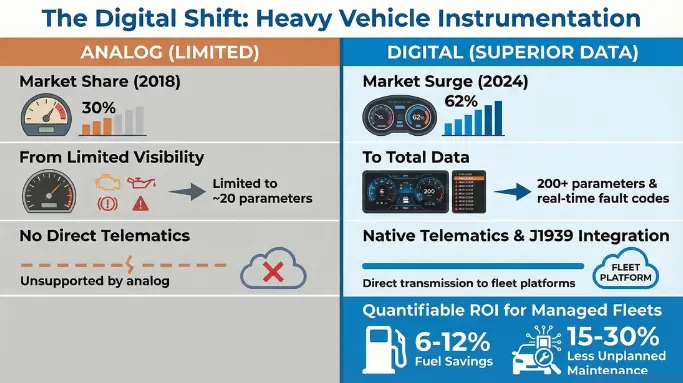
The global heavy vehicle instrumentation market is expected to reach USD 8.1 billion by 2027, according to Fortune Business Insights. Within that figure, the share represented by digital display technology has grown from approximately 30 percent in 2018 to an estimated 62 percent in 2024, with continued acceleration expected as telematics integration requirements become standard in commercial fleet procurement.
What Analog Clusters Actually Do Well
I want to start here because the analog cluster’s strengths are real and underappreciated in a market that has a strong commercial incentive to promote digital alternatives.
Mechanical simplicity: A traditional analog cluster has a limited number of components that can fail. The gauge movements are electromechanical. The warning lights are direct-wired. There is no firmware, no software update requirement, and no display processor that can malfunction or require rebooting. For operators who value repairability in remote locations without specialized tooling, this simplicity has genuine operational value.
Instant operator familiarity: Experienced operators who have spent decades reading analog gauges read them accurately and efficiently without conscious effort. The relative position of a needle on a graduated arc is processed peripherally, without the focused attention that reading a numerical value from a digital display requires. For short-duration, frequent-glance parameters like engine speed and road speed, an experienced operator may actually extract information faster from an analog gauge than from a digital readout.
Resilience to software failures: Digital cluster platforms depend on software that can have bugs, require updates, and occasionally fail in ways that produce incorrect displayed values without any hardware fault. An analog gauge that is mechanically and electrically functional will display the correct value. A digital display showing a software-generated incorrect value provides no visible indication that the displayed data is wrong. For safety-critical parameters, this distinction has operational significance.
Lower initial cost in simple applications: For equipment where only 8 to 12 parameters need to be displayed, where telematics integration is not required, and where the operating environment does not stress display electronics, an analog cluster can be a cost-appropriate choice that delivers adequate operational capability without the overhead of a digital platform.
Where Analog Clusters Fall Short in Modern Operations
The strengths of analog clusters are real but bounded. In modern professional fleet and construction operations, several gaps make them increasingly inadequate.
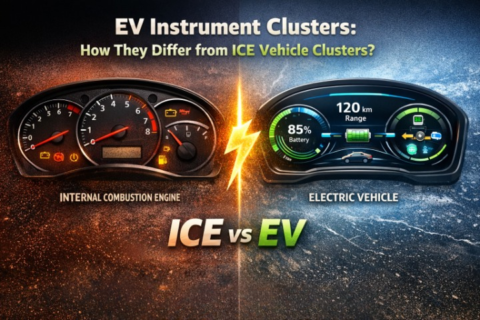
Limited parameter capacity: A typical analog cluster can display 12 to 20 parameters. A modern commercial truck engine ECU monitors more than 200 parameters. Everything the ECU knows about the vehicle’s operational state that the cluster cannot display is invisible to the driver. Fault conditions that do not trigger one of the handful of hard-wired warning lights go unnoticed until they escalate to a major failure.
No fault code display: When a J1939 fault code is generated, an analog cluster’s only response is a generic warning light. The driver knows something is wrong but has no information about what. A digital cluster displays the fault description, severity level, and recommended action. The difference in the driver’s ability to respond appropriately is significant.
No telematics integration: Fleet management platforms need real time data from every vehicle in the fleet. An analog cluster cannot transmit vehicle operating data to a telematics platform. Fleet operators using analog clusters are dependent on manual driver reporting or OBD-II dongle-based aftermarket telematics devices, which provide limited parameter sets and no display feedback to the driver.
Inflexibility as vehicle systems evolve: When an OEM updates the engine management system or adds new emissions monitoring requirements, a digital cluster’s firmware can be updated to display the new parameters. An analog cluster’s fixed gauge set cannot adapt. Fleet operators using analog clusters on older vehicles find themselves with an increasing number of vehicle systems that generate data no one in the cab can see.
What Digital Clusters Add: A Direct Comparison
The table below provides a direct operational comparison between analog and digital instrument cluster implementations in heavy vehicle applications, across the criteria that most directly affect fleet operations.
| Criterion | Analog Cluster | Digital Cluster | Best Suited For |
|---|---|---|---|
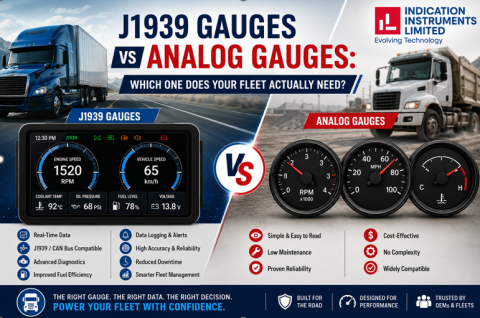
| Parameter Capacity | 12 to 20 fixed parameters | 60 to 200+ configurable parameters | Digital for complex vehicles |
| Fault Code Display | Generic warning light only | Real time DTC with text description | Digital for all fleet applications |
| Telematics Integration | Not supported natively | Direct J1939 TCU integration | Digital for managed fleets |
| Driver Performance Feedback | None | Live coaching display and scores | Digital for safety-focused fleets |
| ADAS Alert Rendering | Not supported | Full alert overlay capability | Digital for modern vehicle platforms |
| Display Configurability | None: fixed gauge layout | Operator-configurable zones and parameters | Digital for multi-role equipment |
| OTA Configuration | Not applicable | Remote display configuration update | Digital for large fleets |
| Software Failure Risk | None (hardware only) | Firmware bugs possible, requires management | Analog for simplest applications |
| Maintenance and Repair | Simple, field-repairable | Requires trained technician or unit replacement | Analog for very remote operations |
| Initial Cost | Lower for basic requirements | Higher initial cost, lower TCO at scale | Analog for budget-constrained simple programs |
| Electrification Compatibility | Very limited | Full EV and hybrid parameter support | Digital for electrified fleets |
The Migration Case: How to Structure the Decision
For fleet operators considering the migration from analog to digital clusters on an existing fleet, the decision framework I use starts with three questions.
What parameters are you currently not seeing? Audit the gap between what your vehicle ECUs monitor and what your analog clusters display. If that gap contains parameters that would materially affect driver decisions, maintenance scheduling, or fleet compliance, the case for digital is strengthened directly.
What does fleet management platform integration cost you without digital clusters? Calculate the manual data entry effort, aftermarket OBD-II dongle costs, and management overhead associated with operating a fleet without real time telematics integration. The operational cost of the analog baseline is often the most compelling element of the digital ROI calculation.
What is the service life of the vehicles in question? If the vehicles are within three years of scheduled replacement, the investment in digital cluster retrofitting may not recover within the remaining service life. In that case, specifying digital clusters on the replacement vehicles is the cleaner approach. For vehicles with 8 to 15 years of remaining service life, the upgrade economics typically favor retrofit.
Retrofit options range from aftermarket plug-in OBD-II display modules for light applications to full cluster replacement programs with J1939-integrated digital display units. The right scope depends on the vehicle’s network architecture and what level of integration the fleet management platform requires.
For retrofit and new-vehicle digital cluster options for heavy vehicle applications, the product range at Indication Instruments covers a spectrum of capability levels matched to different operational and budget requirements.
When Analog Still Makes Sense
I do not believe every heavy vehicle application should move to digital instrumentation. There are contexts where analog remains appropriate.
Very simple equipment with a small parameter set and no telematics requirement, such as a single-function industrial pump unit or a low-duty-cycle static generator set, does not benefit materially from a digital cluster. The additional cost buys no operational value in these applications.
Environments where display electronics face extreme levels of electromagnetic interference, such as certain high-power welding or induction heating applications, may favor the electromagnetic robustness of simple analog gauge circuits over digital display electronics, though proper EMC design in industrial digital displays addresses most of these concerns in practice.
Legacy vehicle platforms with non-standard sensor outputs that are not CAN-based may require analog displays as the path of least resistance, unless a signal conditioning interface is installed to convert legacy sensor signals to CAN bus messages.
If you are assessing whether digital or analog is the right choice for a specific application, the team at Indication Instruments can provide an objective application assessment.
Frequently Asked Questions
Q1: Can digital instrument clusters replace analog ones without changing the vehicle’s existing wiring?
In most cases, yes with qualifications. If the vehicle has a CAN bus network, a CAN-connected digital display can read vehicle data without replicating the individual sensor wiring of the analog cluster. However, the physical mounting dimensions, connector footprints, and power supply requirements need to be confirmed for each specific vehicle and cluster combination. A direct drop-in replacement is possible in some applications but should not be assumed without verification.
Q2: Are there heavy vehicle applications where analog clusters are still specified as new equipment?
Yes. Some specialized industrial vehicles and construction machines continue to use analog instrumentation where the application is simple, the service environment is extreme in ways that challenge digital electronics, and the operator base has strong familiarity with analog gauge interfaces. These cases are becoming less common as digital platform robustness improves and the telematics integration value proposition becomes more compelling across all commercial vehicle segments.
Q3: How long does it take to train operators on a digital cluster interface after migration from analog?
In a well-designed digital cluster with a clear, logical interface, operators familiar with the equivalent analog cluster typically reach comfortable operation within one to two shifts. The transition is most straightforward when the digital cluster’s default parameter display closely mirrors the layout and parameter set of the analog unit it replaces. Operators who struggle most are those who were expert at reading the subtle nuances of an analog gauge movement and find the transition to discrete digital readout counterintuitive.
Q4: What is the typical ROI timeline for a fleet-wide digital cluster upgrade program?
For large managed fleets, the ROI is typically driven by three factors: fuel savings from real time driver coaching (6 to 12 percent, recovering within 12 to 18 months at typical fleet fuel costs), maintenance cost reduction from earlier fault detection (15 to 30 percent reduction in unplanned maintenance, recovering within 18 to 24 months), and reduced fleet management labor through automated telematics reporting. Combined, these typically produce an ROI within 2 to 3 years for fleets of 50 or more vehicles.
Q5: Do digital clusters require more maintenance than analog ones?
Digital clusters require less mechanical maintenance than analog gauge movements, which have wear components including the needle bearings and stepper motors in electrical analog gauges. Digital clusters require firmware update management, which is a software maintenance task with no equivalent in analog systems. The total maintenance burden is generally lower for digital units in normal operating conditions, but the failure mode, a display electronics fault versus a gauge movement fault, requires different diagnostic skills.
Q6: Where can I compare analog and digital cluster options for my heavy vehicle application?
Indication Instruments offers both traditional and digital instrumentation solutions across a range of heavy vehicle applications. The team can help assess which approach best matches your specific operational requirements and budget.
Related Articles
- Digital Gauges vs Mechanical Gauges in Heavy Machinery: A Technical Comparison
- Advanced Digital Instrument Clusters for Heavy Duty Trucks and Industrial Vehicles
- How Modern Instrument Clusters Improve Driver Awareness and Vehicle Diagnostics
- CAN Bus Integration in Digital Displays: How It Improves Vehicle Performance
- Rugged Instrument Clusters for Off-Highway Vehicles: Features and Benefits

Chief Technology Officer, Indication Instruments Ltd.
Anuj Garg has led the engineering and product development function at Indication Instruments for more than 2 decades, overseeing the design and manufacture of instrument clusters, sensors, and driver information systems for ICE and EV platforms across commercial vehicle, and off-road segments. He has hands-on experience with cluster architecture for BS6 commercial vehicles, electric 3-wheelers, fleet applications, heavy vehicles, farm equipments, and leads the company’s technology roadmap.
LinkedIn: Anuj Garg