Powered by Smartsupp Rojalin Sethi, Author at Indication Instruments Ltd.
Why OEMs Are Moving from Analog to Fully Digital Clusters in Commercial & Off-Highway Vehicles

Why OEMs Are Moving from Analog to Fully Digital Clusters in Commercial & Off-Highway Vehicles

why oems digital clusters banner (3)
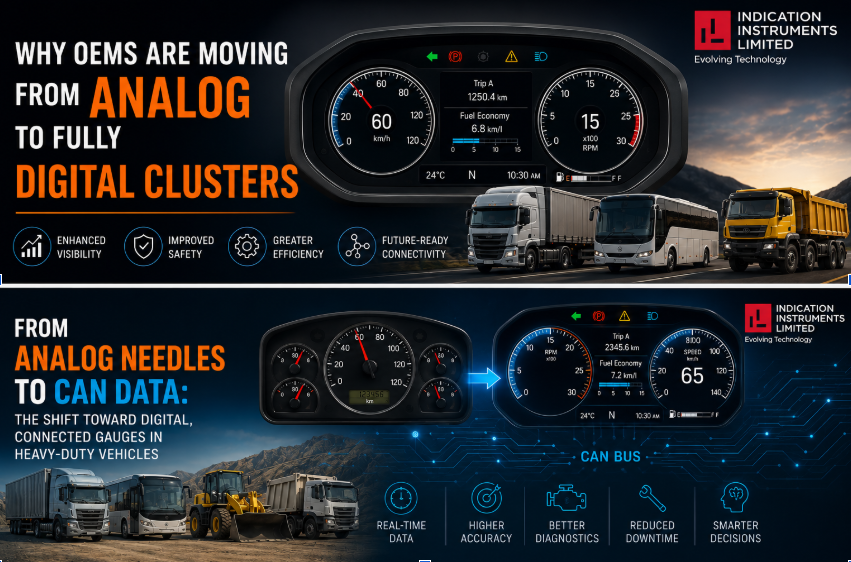
Analog needles and dial faces defined vehicle dashboards for decades. That’s changing fast — and not just in passenger cars. Truck, bus, tractor, and construction equipment OEMs are now specifying fully digital clusters as standard, not premium, equipment. Here’s what’s driving the shift, backed by current market data, and what it means if you’re evaluating a digital display partner for your next program.

What Is Driving the Shift from Analog to Digital Instrument Clusters?

The move is being pulled by three forces at once: electrification, which needs new data types (battery state, range, charging status) that analog gauges can’t show; rising OEM demand for configurable, brand-differentiated dashboards; and safety regulation pushing toward consolidated, distraction-reducing driver information systems. The trend toward integrating HMI and AI systems with instrument clusters is expected to continue, and high-quality displays are needed to support that integration.

How Big Is the Digital Instrument Cluster Market Right Now?

This isn’t a niche shift — it’s a mainstream one. The global automotive digital instrument cluster market was valued at roughly $3.77 billion in 2025 and is projected to reach $4.33 billion in 2026, growing at a 14.7% CAGR, with growth linked to rising adoption of digital displays in vehicles, falling LCD and TFT panel costs, increasing vehicle electrification, and standardization of electronic control units. A separate market view puts the broader digital instrument cluster segment at $8.45 billion in 2025 growing to $9.87 billion in 2026 at an 18.07% CAGR — different scopes, same direction: fast, sustained growth.

Why Are OEMs Choosing Larger, Higher-Resolution Displays?

A key trend is the move toward larger, clearer digital displays that improve readability and interface customization, supporting navigation, vehicle data, and driver-assistance alerts more effectively. For commercial and off-highway equipment specifically, this translates into fewer physical gauges, more consolidated data on a single high-resolution TFT screen, and better legibility for operators working in bright sunlight, dust, or vibration-heavy environments — exactly the conditions covered by IIL’s L10, L10.25, and N12.3 displays.

Is Vehicle Electrification Really Accelerating This Shift?

Yes. Analog gauges were built to show speed, RPM, fuel, and temperature — not battery charge, range, regenerative braking status, or motor temperature. India’s automotive sector is increasingly shaped by AI, IoT, robotics, and software-defined vehicles, with a strong focus on EVs and connected vehicles positioning the country as a leader in sustainable mobility. EV and hydrogen truck, forklift, and genset programs simply need a screen, not a needle, to display this data — a core reason IIL’s own digital display range is purpose-built for EV and hydrogen vehicle applications.

Are AI and Smart HMI Features Becoming Standard in Clusters?

They’re heading that way. The application and integration of HMI and AI systems with instrument clusters is expected to increase, and this requires high-quality displays to support it. For OEMs, that means specifying displays today with enough processing headroom, input flexibility, and firmware-update capability to support smarter features tomorrow — without a full hardware redesign.

What Role Does India Play in Global Digital Cluster Manufacturing?

A growing one. India is projected to see a 23.5% CAGR in the digital instrument cluster market through 2035, among the fastest of any region tracked. That’s consistent with the wider “China+1” sourcing shift, where global OEMs are actively adding India-based electronics manufacturers to reduce single-source risk — a trend covered in more depth in our companion piece on gauge sourcing from India.

What Should OEMs Look for When Choosing a Digital Cluster Supplier?

Four things matter most when specifying a supplier for a multi-year program:

● Protocol compatibility — confirmed CAN2.0B or J1939 support matching your ECU
● Reliability compliance — documented IP65/IP67 and EMC test data, not just datasheet claims
● Update flexibility — UDS bootloader or firmware updates for field servicing
● Manufacturing continuity — a supplier with local engineering support and supply-chain resilience, not a single overseas source

Why Choose Indication Instruments Limited for Digital Clusters?

IIL has manufactured automotive and construction equipment displays for over 30 years, with both Made-in-India and Made-in-USA product lines including the L10.25, N76, and T7i. Every display supports CAN2.0B/J1939 protocols, IP65/IP67 and EMC compliance, and UDS-bootloader field updates, and can be paired with matching gauges, instrument clusters, and sensors & switches for a single-vendor dashboard. Review our quality certificates or product catalogues to start evaluation.

FAQs

Why are OEMs replacing analog gauges with digital clusters? Analog gauges can’t display the data types modern vehicles need — EV battery status, diagnostics, camera feeds — and digital clusters consolidate this information on one configurable, higher-resolution screen.

Is this shift only happening in passenger cars? No. Commercial vehicles, buses, tractors, construction equipment, and gensets are adopting digital clusters at a comparable pace, driven by electrification and the need for CAN/J1939-based diagnostics.

Do digital clusters cost more than analog gauges? Initial unit cost can be higher, but falling TFT/LCD panel costs and reduced wiring complexity are narrowing the gap, especially at OEM production volumes.

What communication protocol do most digital clusters use? Most commercial and off-highway digital clusters use CAN2.0B or the SAE J1939 protocol, which must match the vehicle’s ECU for proper integration.

Can digital clusters be customized for OEM branding? Yes — resolution, telltale icon sets, startup branding, and layout can typically be customized to match OEM dashboard design requirements.

Ready to specify a digital cluster for your next program? Talk to IIL’s engineering team about CAN/J1939-compliant displays built for commercial and off-highway applications.

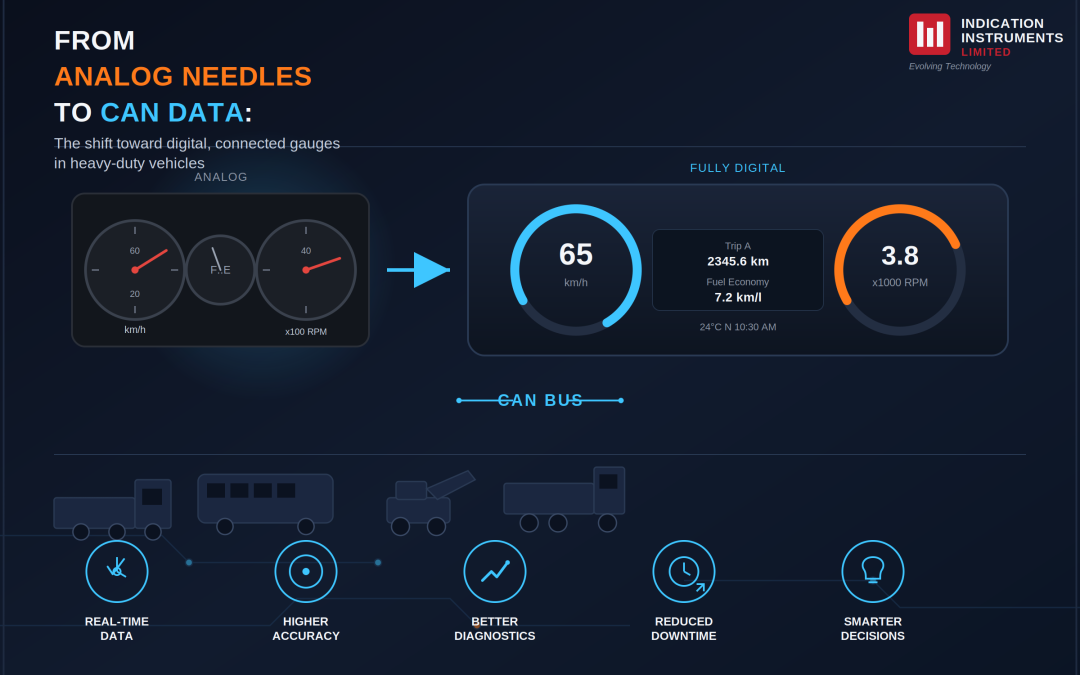
From Analog Needles to CAN Data: The Shift Toward Digital, Connected Gauges in Heavy-Duty Vehicles

From Analog Needles to CAN Data: The Shift Toward Digital, Connected Gauges in Heavy-Duty Vehicles

Digital Clusters

For decades, a needle sweeping across a dial was how a truck driver knew engine temperature,
fuel level, or RPM. That's changing. Heavy-duty vehicles — trucks, buses, gensets, construction
equipment — are increasingly reading these same parameters off a CAN bus, displayed

through connected digital gauges rather than mechanical pointers. Here's why this shift is
happening now, and what it means if you're specifying instrumentation for your next OEM
program.

What’s the Difference Between an Analog Gauge and a Digital, CAN-Connected Gauge?

An analog gauge reads a physical signal directly — a sender unit’s resistance, a mechanical pressure line — and moves a needle proportionally. A digital, CAN-connected gauge instead reads data broadcast over the vehicle’s CAN bus (often using the SAE J1939 protocol), then displays it through a stepper-motor pointer, LCD readout, or bar graph. The mechanical result can look similar; the underlying architecture is entirely different, and far more capable.

Why Are Heavy-Duty Vehicles Moving Toward CAN-Based Gauges?

The broader instrument cluster market is seeing systems evolve from traditional analog clusters to advanced digital formats, driven by rapid adoption of innovative technologies across the automotive sector. For heavy-duty and off-highway vehicles specifically, CAN-based gauges solve a problem analog wiring can’t: a single CAN bus can carry dozens of parameters — fuel, DEF/AdBlue level, engine hours, fault codes — over one connector, instead of a dedicated wire and sender for every gauge. That simplifies wiring harnesses and improves diagnostic depth at the same time.

Does Electrification Change What Gauges Need to Display?

Significantly. India’s automotive sector is increasingly shaped by AI, IoT, robotics, and software-defined vehicles, with a strong push toward EVs, connected vehicles, and sustainable mobility. Traditional fuel and coolant-temperature gauges don’t translate to battery-electric gensets or hydrogen-powered off-highway equipment — but a CAN-connected digital gauge can be reprogrammed to display battery state of charge, motor temperature, or hydrogen tank pressure without changing the physical hardware. This is why IIL’s J1939 gauges are built with reprogrammable displays rather than fixed mechanical scales.

Are Analog Gauges Becoming Obsolete?

Not entirely — and OEMs shouldn’t assume digital is automatically the right answer everywhere. Simple, cost-sensitive applications like basic gensets or entry-level construction equipment still use mechanical temperature and pressure gauges effectively, since they don’t need CAN integration and are cheaper to source and service. The shift toward digital is strongest where the vehicle already has a CAN bus for other systems (engine ECU, transmission, telematics) — at that point, tapping into existing CAN data for gauges is more efficient than running separate analog sender wiring.

What Are the Practical Benefits of CAN-Connected Gauges for Fleet Operators?

1- Fewer wiring failures — one CAN connection replaces multiple analog sender wires, a common failure point in vibration-heavy environments
2- Richer diagnostics — fault codes and threshold warnings can be built into the gauge display itself, not just a separate warning light
3- Easier calibration — pulse and threshold settings can often be configured in the field rather than requiring gauge replacement
4- Consistent data across the dashboard — a CAN-connected gauge and a digital display can show the same underlying data without duplicate sensors

How Should OEMs Decide Between Analog and Digital Gauges?

The decision usually comes down to three questions: Does the vehicle already run a CAN2.0B or J1939 bus for other systems? Does the application need reprogrammable thresholds or multi-parameter display (like a combined fuel/hour meter)? And does the OEM need field-level diagnostic data, not just a dashboard reading? If the answer to any of these is yes, a CAN-connected digital gauge is usually the better long-term choice — even if the upfront unit cost is slightly higher than an analog equivalent.

What Should OEMs Verify Before Specifying a Digital Gauge Supplier?

1- Confirmed support for the exact protocol in use — CAN2.0B or J1939 — not just “CAN compatible” on paper.
2- ISO16750 compliance with documented test reports for vibration, dust, water, temperature & humidity resistance.
3- Field-configurable pulse and threshold settings to avoid re-ordering hardware for calibration changes.
4- A supplier that offers both analog and digital gauge lines, so simpler applications aren’t over-engineered unnecessarily

Why Do OEMs Choose Indication Instruments Limited for Gauge Instrumentation?

IIL manufactures both analog and digital gauges — including speedometers, tachometers, J1939 gauges, and hour meters — engineered for 9V–32V compatibility across 12V and 24V systems, with IP65 and ISO16750-2-compliant construction. As a single-vendor supplier for gauges, digital displays, instrument clusters, and sensors & switches, IIL simplifies sourcing whether your program needs mechanical simplicity or full CAN connectivity. Review our quality certificates or product catalogues to start evaluation.

FAQs

What is a CAN-connected gauge? A CAN-connected gauge reads vehicle data broadcast over the CAN bus — often via the SAE J1939 protocol — instead of a dedicated analog sender wire, and displays it through a stepper-motor pointer or digital readout.

Do CAN gauges require a J1939-compliant vehicle? Yes — the vehicle’s ECU and CAN bus need to broadcast data in a protocol the gauge supports, typically CAN2.0B or J1939, for the gauge to read and display it correctly.

Are digital gauges more reliable than analog ones? Digital, CAN-connected gauges reduce the number of physical sender wires, which lowers one common failure point, but reliability ultimately depends on build quality and environmental compliance (IP rating, EMC) regardless of gauge type.

Can one digital gauge display multiple parameters? Yes — multi-function digital gauges can display fuel level, pressure, voltage, and temperature on a single unit, reducing dashboard clutter.

Should EV or hydrogen vehicle programs use CAN-connected gauges? Generally yes, since these platforms need to display parameters like battery state of charge or hydrogen tank pressure that don’t map to traditional analog sender technology.

Specifying gauges for a heavy-duty or EV program? Contact IIL’s engineering team to discuss analog and CAN/J1939-based gauge options for your application.


EV Battery Current & Voltage Sensors: Why They Matter for Battery Management Systems and Commercial Vehicle Safety

EV Battery Current & Voltage Sensors: Why They Matter for Battery Management Systems and Commercial Vehicle Safety

EV Battery

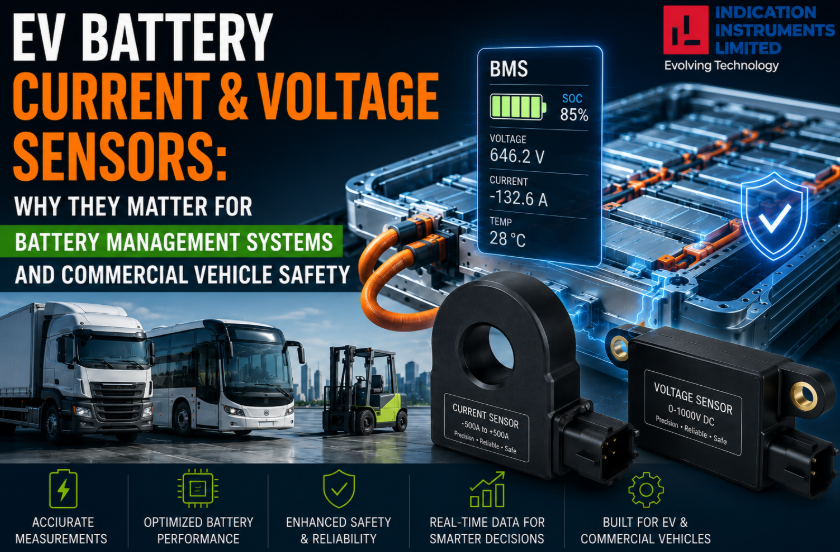
As electric commercial vehicles continue gaining adoption, battery systems have become the most valuable and technically complex component of the vehicle. Whether powering an electric bus, delivery truck, construction machine, or agricultural vehicle, the battery pack must continuously operate within safe electrical limits while delivering reliable performance under varying load conditions.

This is why battery current and voltage sensors have become essential components of every modern Battery Management System (BMS). These sensors provide the real-time electrical measurements required to calculate battery health, estimate remaining driving range, manage charging, detect faults, and protect high-voltage systems from potentially damaging operating conditions. Without accurate sensing, even the most advanced BMS cannot make reliable control decisions.

Why Battery Monitoring Is Critical in Electric Vehicles

Unlike internal combustion engine vehicles, electric vehicles depend entirely on battery performance. Every acceleration event, regenerative braking cycle, charging session, and auxiliary electrical load changes the battery’s operating conditions.

A Battery Management System continuously monitors these changes to maintain safe operation. However, the BMS does not directly measure electrical conditions on its own. Instead, it relies on high-precision current and voltage sensors that supply accurate data multiple times every second.

This information allows the BMS to calculate critical operating parameters, including:

State of Charge (SOC)
State of Health (SOH)
Remaining battery capacity
Charge and discharge current
Cell voltage balance
Power consumption
Fault detection
Thermal management requirements

These calculations directly influence vehicle safety, battery lifespan, charging efficiency, and overall driving performance.

Understanding Battery Current Sensors

Current sensors measure the amount of electrical current flowing into and out of the battery pack.

Every charging cycle, regenerative braking event, or vehicle acceleration causes current to change rapidly. Accurate measurement allows the BMS to determine exactly how much energy enters or leaves the battery.

Modern electric commercial vehicles commonly use Hall Effect sensors or shunt-based current measurement technologies because they provide high accuracy while supporting continuous real-time monitoring under demanding operating conditions.

Current sensors help the BMS:

Calculate State of Charge accurately
Detect abnormal current spikes
Prevent over-current conditions
Monitor regenerative braking
Improve charging efficiency
Protect battery components

Without reliable current measurement, battery capacity estimation gradually becomes inaccurate, reducing both vehicle performance and driver confidence.

Why Voltage Sensors Are Equally Important

Voltage sensors monitor individual battery cells as well as overall pack voltage.

Lithium-ion battery packs contain hundreds of cells connected in series and parallel. Small voltage differences between cells may indicate imbalance, aging, or developing faults that could reduce battery life if left uncorrected.

Voltage monitoring enables the Battery Management System to balance cells, identify weak modules, and detect abnormal operating conditions before they escalate into safety risks.

Accurate voltage sensing also supports:

Over-voltage protection
Under-voltage protection
Safe charging
Cell balancing
Fault diagnostics
Energy optimization

Together, current and voltage sensors provide the electrical intelligence required for safe battery operation.

The Role of Sensors in Commercial Electric Vehicles

Commercial EVs operate under far more demanding conditions than passenger vehicles. Heavy payloads, long operating hours, repeated charging cycles, and varying environmental conditions place additional stress on battery systems.

Battery current and voltage sensors help fleet operators maintain vehicle availability by enabling predictive maintenance, reducing unexpected failures, and supporting efficient energy management.

In electric buses, sensor data helps optimize charging schedules and maximize route efficiency. In construction and mining equipment, continuous monitoring protects battery systems operating under high load conditions. Agricultural machinery benefits from improved energy utilization while minimizing equipment downtime during seasonal operations.

As electrification expands into heavy-duty applications, battery sensing accuracy becomes increasingly important for both vehicle reliability and total cost of ownership.

Key Considerations When Selecting Battery Sensors

Choosing the right battery sensor requires evaluating more than measurement accuracy.

Engineers should consider operating voltage range, measurement precision, response time, temperature stability, electromagnetic compatibility (EMC), environmental protection, and long-term reliability. Compatibility with CAN Bus communication and seamless integration into Battery Management Systems are equally important for modern commercial vehicle platforms.

Automotive-grade sensors should also comply with stringent validation requirements, ensuring reliable performance under vibration, humidity, dust, and extreme temperature conditions commonly experienced in commercial and off-highway environments.

Selecting sensors designed specifically for automotive applications reduces integration complexity while supporting long-term product durability.

Future Trends in Battery Sensing Technology

Battery sensing technology continues evolving alongside electric vehicle architectures.

Modern systems increasingly combine current sensing, voltage monitoring, temperature measurement, and diagnostic intelligence into integrated electronic modules. Higher accuracy enables more precise State of Charge estimation, extending driving range while improving charging efficiency.

The growing adoption of connected vehicles also allows battery data to be transmitted through telematics platforms, enabling remote diagnostics, predictive maintenance, and fleet-wide battery performance monitoring. These capabilities will become increasingly valuable as commercial EV adoption accelerates over the coming decade.

Choosing the Right Sensor Partner

For OEMs developing electric commercial vehicles and off-highway equipment, selecting the right sensor supplier is as important as selecting the sensor itself. Engineering support, automotive validation expertise, customization capabilities, and long-term manufacturing reliability all contribute to successful vehicle integration.

Indication Instruments offers automotive-grade sensors and electronic solutions engineered for demanding commercial vehicle and industrial applications. Combined with expertise in vehicle instrumentation and electronic systems, these solutions help OEMs build reliable, future-ready platforms capable of meeting evolving electrification requirements.

Frequently Asked Questions

What are EV battery current and voltage sensors?

They are automotive-grade electronic sensors that measure electrical current and voltage within a battery pack, providing real-time data to the Battery Management System for monitoring, protection, and performance optimization.

Why are current sensors important in a Battery Management System?

Current sensors enable accurate State of Charge calculations, monitor charging and discharging, detect abnormal current flow, and protect the battery from overload conditions.

What is the role of voltage sensors in electric vehicles?

Voltage sensors continuously monitor individual battery cells and total pack voltage, helping the Battery Management System maintain cell balance, optimize charging, and prevent over-voltage or under-voltage conditions.

Can battery sensors communicate through CAN Bus?

Yes. In many commercial EV architectures, sensor data is processed by the Battery Management System and transmitted over the CAN Bus, allowing instrument clusters, telematics systems, and other vehicle controllers to access real-time battery information.

Which industries benefit from automotive battery sensing solutions?

Battery current and voltage sensors are widely used in electric trucks, buses, agricultural machinery, construction equipment, mining vehicles, material handling equipment, and other commercial and off-highway electric platforms where reliable battery monitoring is essential.

CAN J1939 Digital Display Integration: A Buyer’s Guide for Trucks, Buses & Off-Highway Vehicles

CAN J1939 Digital Display Integration: A Buyer’s Guide for Trucks, Buses & Off-Highway Vehicles

J1939 Digital Display

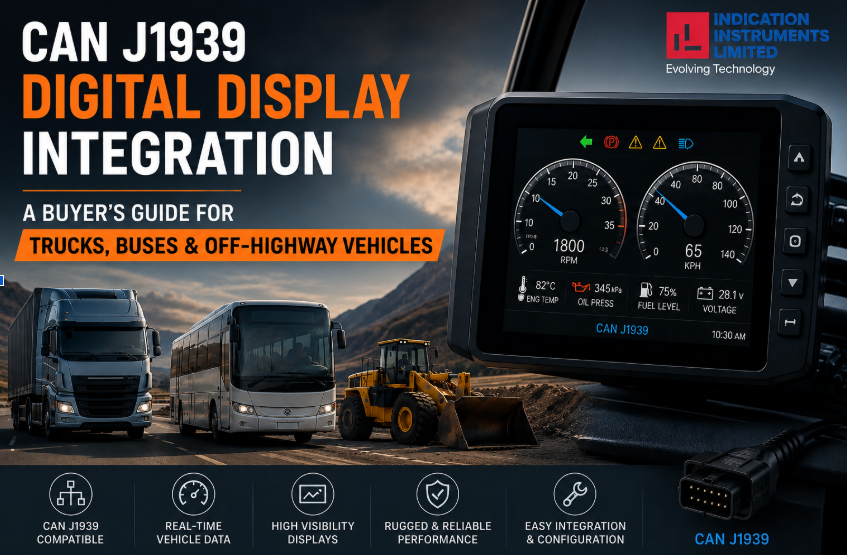
As commercial vehicles and off-highway equipment become increasingly connected, the instrument cluster is no longer just a dashboard—it has evolved into an intelligent Human-Machine Interface (HMI) that communicates with multiple Electronic Control Units (ECUs) in real time. At the center of this communication is SAE J1939, the industry-standard protocol built on the Controller Area Network (CAN Bus), enabling seamless data exchange between the engine, transmission, braking system, body controller, and other onboard electronics.

For OEMs, commercial vehicle manufacturers, bus builders, agricultural equipment companies, and construction machinery manufacturers, integrating a CAN J1939 digital display is no longer just a technology upgrade. It is a strategic investment that improves driver experience, simplifies diagnostics, supports regulatory compliance, and prepares vehicles for future software-defined architectures. This guide explains what buyers should evaluate before selecting a J1939-compatible digital display and how the right solution can reduce development complexity while delivering long-term business value.

Understanding CAN J1939 and Why It Matters

SAE J1939 is the most widely adopted communication protocol for heavy-duty vehicles, allowing different electronic systems to exchange information over a shared CAN Bus network. Rather than using dedicated wiring between every component, J1939 enables ECUs to broadcast standardized messages that any authorized device on the network can interpret.

A digital display integrated with J1939 continuously receives operational data such as engine speed, coolant temperature, oil pressure, transmission status, fuel consumption, battery voltage, and diagnostic fault information. Instead of displaying isolated gauge readings, the display consolidates multiple vehicle parameters into a single interface, allowing drivers and operators to monitor vehicle performance more efficiently.

This standardized communication has made J1939 the preferred protocol across commercial trucks, buses, mining equipment, agricultural machinery, fire trucks, military vehicles, and other heavy-duty applications where reliability and interoperability are essential.

Why OEMs Are Moving Toward J1939 Digital Displays

Modern commercial vehicles contain dozens of ECUs managing everything from powertrain performance to emissions control and safety systems. As vehicle electronics continue to expand, traditional analog gauges struggle to present growing volumes of information in a meaningful way.

A CAN J1939 digital display simplifies this complexity by acting as a centralized visualization platform. Rather than requiring separate indicators for every subsystem, operators receive contextual information, graphical alerts, maintenance reminders, and diagnostic messages through a single interface.

This approach offers several operational advantages. Drivers can identify potential issues before they lead to vehicle downtime, service technicians gain faster access to diagnostic information, and OEMs benefit from a scalable platform that supports multiple vehicle models with software-based customization rather than hardware redesigns.

Key Features Buyers Should Evaluate

Selecting a CAN J1939 digital display involves much more than choosing the right screen size. The display becomes a critical component of the vehicle’s electronic architecture, making compatibility, reliability, and scalability essential considerations.

The first priority should be protocol compatibility. A display should fully support SAE J1939 communication while allowing manufacturers to configure custom Parameter Group Numbers (PGNs) and Suspect Parameter Numbers (SPNs) when application-specific requirements exist. This flexibility ensures the display can communicate with engines, transmissions, hydraulic systems, and auxiliary equipment from different suppliers without extensive software redevelopment.

Display readability is equally important, particularly for commercial and off-highway vehicles operating in challenging environments. High-brightness TFT displays with anti-glare technology, wide viewing angles, and automatic brightness adjustment improve visibility in direct sunlight, low-light conditions, and dusty job sites.

Durability should also be a major purchasing criterion. Displays designed for construction equipment, mining vehicles, agricultural machinery, and heavy-duty trucks should withstand vibration, shock, moisture, and extreme operating temperatures while maintaining long-term reliability.

Finally, software flexibility has become a significant differentiator. Modern digital displays allow OEMs to customize screen layouts, warning priorities, branding, language options, operating modes, and user interfaces without changing hardware, reducing engineering effort across multiple vehicle platforms.

How J1939 Displays Improve Vehicle Performance

Beyond displaying vehicle information, digital displays contribute directly to operational efficiency. Because they receive live data from multiple ECUs, they can prioritize safety-critical alerts, monitor system health, and provide predictive maintenance notifications before failures occur.

For fleet operators, this translates into reduced unplanned downtime and improved maintenance planning. Instead of relying solely on scheduled servicing, maintenance teams can respond to actual vehicle conditions, minimizing unnecessary repairs while extending component life.

Drivers also benefit from improved situational awareness. Rather than interpreting multiple warning lamps or mechanical gauges, they receive intuitive graphical interfaces that present the most relevant information based on current operating conditions. This reduces cognitive workload while improving response times during critical events.

Applications Across Commercial and Off-Highway Industries

The flexibility of CAN J1939 gauges makes them suitable for a wide range of heavy-duty vehicle applications.

Commercial truck manufacturers use digital displays to present vehicle diagnostics, fuel economy information, Advanced Driver Assistance System (ADAS) alerts, and navigation data. Bus manufacturers integrate passenger transport information, fleet communication, and maintenance diagnostics into centralized dashboards.

In agricultural machinery, operators rely on J1939 displays to monitor engine performance, hydraulic systems, PTO engagement, and implement status while working in demanding field conditions. Construction and mining equipment manufacturers use the same communication architecture to display hydraulic pressure, machine operating hours, payload information, and fault diagnostics that improve equipment utilization and reduce service interruptions.

Because J1939 is already widely adopted throughout these industries, manufacturers can standardize display platforms across multiple product lines while reducing integration complexity.

Common Integration Challenges

Although J1939 is a standardized protocol, successful implementation still requires careful planning.

One of the most common challenges involves interpreting proprietary PGNs used by different engine or subsystem manufacturers. While standardized messages ensure interoperability, OEM-specific parameters often require additional configuration to display information correctly.

Another consideration is ensuring the display architecture remains scalable. As vehicles adopt electrification, telematics, and software-defined capabilities, additional data sources will continue to emerge. Selecting a display platform that supports firmware updates and future software enhancements helps protect long-term investments while reducing redevelopment costs.

Working with an experienced instrument cluster manufacturer such as Indication Instruments can significantly reduce integration risks by providing application engineering, software customization, CAN J1939 integration expertise, validation testing, and long-term technical support throughout the vehicle development lifecycle. For OEMs developing commercial vehicles and off-highway equipment, partnering with a supplier that understands both automotive electronics and real-world operating environments can accelerate product development while ensuring long-term reliability.

How to Choose the Right CAN J1939 Display Supplier

Selecting the right supplier extends beyond product specifications. Buyers should evaluate engineering expertise, automotive quality standards, customization capabilities, manufacturing scalability, and post-development support.

An experienced supplier should understand commercial vehicle architectures, CAN Bus communication, automotive HMI design, environmental validation requirements, and industry standards applicable to heavy-duty applications. The ability to customize display graphics, integrate customer branding, support multiple vehicle variants, and provide long-term product availability is equally important for OEM programs with extended production cycles.

Choosing a partner rather than simply a component supplier helps streamline development while ensuring the display evolves alongside future vehicle technologies.

Strengthen Your Vehicle Platform with Intelligent Display Solutions

As connected vehicles continue transforming the commercial transportation and off-highway equipment industries, CAN J1939 digital displays have become essential components for delivering operational intelligence, improved safety, and enhanced driver experiences. Their ability to consolidate complex vehicle data into an intuitive interface enables OEMs to build smarter, more efficient, and future-ready vehicle platforms.

Whether you are developing heavy-duty trucks, buses, agricultural machinery, construction equipment, or specialty vehicles, investing in a configurable J1939-compatible display creates long-term value by supporting diagnostics, fleet connectivity, predictive maintenance, and software-driven innovation.

Frequently Asked Questions

What is a CAN J1939 digital display?

A CAN J1939 digital display is an intelligent instrument display that communicates with vehicle Electronic Control Units (ECUs) using the SAE J1939 protocol over a CAN Bus network. It displays real-time vehicle data, diagnostics, and safety alerts in a configurable digital interface.

Which vehicles use SAE J1939 communication?

SAE J1939 is widely used in heavy-duty trucks, buses, construction equipment, agricultural machinery, mining vehicles, fire apparatus, military vehicles, and other commercial vehicle platforms requiring standardized electronic communication.

What information can a J1939 display monitor?

A J1939 display can monitor engine speed, coolant temperature, oil pressure, fuel level, battery voltage, transmission status, hydraulic systems, Diagnostic Trouble Codes (DTCs), ADAS warnings, service reminders, and numerous other vehicle parameters transmitted by Electronic Control Units.

Can a J1939 digital display be customized?

Yes. Most OEM-grade J1939 displays support customized layouts, company branding, multilingual interfaces, warning logic, operating modes, and application-specific screens, allowing manufacturers to tailor the user experience for different vehicle platforms.

Why should OEMs invest in configurable digital instrument displays?

Configurable digital displays reduce hardware complexity, support multiple vehicle variants, simplify software updates, improve diagnostics, enhance driver experience, and provide a scalable foundation for connected, electrified, and software-defined commercial vehicles.