J1939 Gauges vs Analog Gauges: Which One Does Your Fleet Actually Need?
If you spec dashboards for trucks, buses, tractors, gensets, or construction equipment, you’ve probably hit this fork in the road: do you go with a J1939 digital gauge cluster that reads straight off the CAN bus, or stick with a proven analog/electrical gauge wired to a dedicated sender? It’s one of the most common questions OEM engineers, fleet maintenance heads, and equipment integrators search for — and the “right” answer depends less on which technology is newer and more on what your platform, budget, and service network actually look like.
This guide breaks down both options in plain terms, compares them side by side, and gives you a framework for deciding — whether you’re designing a new vehicle platform from scratch or retrofitting an aging fleet.
What Is a J1939 Gauge, in Practical Terms?
SAE J1939 is the communication protocol that lets an engine, transmission, brake system, and dashboard on a heavy-duty vehicle talk to each other over a single shared data network (built on CAN bus). Instead of running a separate physical sender wire from the fuel tank, the oil pan, and the coolant jacket to three different gauges, a J1939 gauge simply listens to the relevant messages already broadcasting on the bus and displays them.
For fleets, this matters for three practical reasons:
Fewer wires, fewer failure points. One data network can feed speed, RPM, temperature, fuel, and voltage to a single cluster instead of a bundle of dedicated sender circuits.
Standardized across brands. A J1939-compliant cluster can be used across different engine and chassis combinations, which is valuable if your fleet mixes makes and models.
Built-in diagnostics. Fault codes and warning states can be pulled from the same bus that feeds the gauge, so the dashboard doubles as a basic diagnostic display.
What Is an Analog / Electrical Gauge, and Why Is It Still Widely Used?
Analog and electrical gauges — air-cored, mechanical, or electrical types — take a direct physical reading from a sender (a thermistor for temperature, a variable resistor for fuel level, a pressure switch for oil) and move a needle accordingly. There’s no protocol translation involved; the sender’s signal drives the gauge directly.
They remain the default choice in a large share of trucks, gensets, compressors, and construction machines for a few reasons:
Lower unit cost, which matters on high-volume, price-sensitive platforms.
Simple to diagnose in the field — a technician with a multimeter can usually trace a fault without a laptop or diagnostic scanner.
No dependency on ECU software or bus wiring quality, which can be an advantage on older equipment or in markets where CAN-capable service infrastructure isn’t yet widespread.
J1939 vs Analog Gauges: Side-by-Side
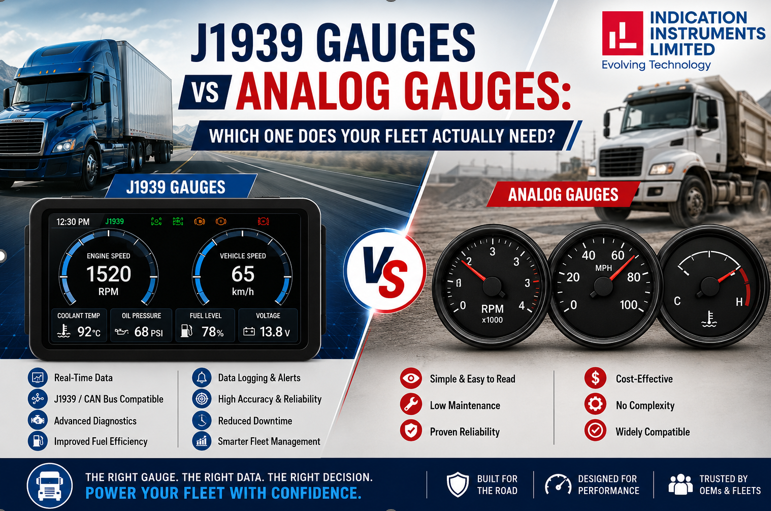
Factor | J1939 Digital Gauge | Analog / Electrical Gauge |
Wiring complexity | Low (single bus connection) | Higher (dedicated sender wire per gauge) |
Diagnostics | Built-in fault codes, live data | Needs separate diagnostic tools |
Cross-platform use | High — works across compliant ECUs | Depends on matching sender specs |
Upfront cost | Generally higher | Generally lower |
Field serviceability | Requires bus/protocol knowledge | Familiar to most mechanics |
Best fit | Mixed fleets, telematics-integrated platforms, modern heavy-duty trucks | Budget builds, older equipment, simple gensets/compressors |
How to Decide: Three Common Buyer Scenarios
You’re an OEM building a new heavy-duty truck or bus platform. If the engine ECU is already J1939-compliant (most modern diesel engines are) and you’re planning to add telematics or fleet-monitoring down the line, a J1939 gauge cluster reduces wiring harness complexity and future-proofs the dashboard for connected features.
You manage a mixed fleet with vehicles of different ages. A hybrid approach is common here — J1939 clusters on newer trucks, analog or electrical gauges on legacy equipment where a CAN-compliant ECU isn’t present. Retrofitting older machines with full J1939 clusters rarely makes financial sense unless the ECU already supports it.
You’re speccing gensets, compressors, or basic construction equipment on a tight budget. Analog and electrical gauges (temperature, pressure, ammeter) are usually the more practical choice here — lower cost, easy field repair, and no dependency on bus wiring quality in dusty or vibration-heavy environments.
A Quick Word on Hybrid and Multi-Function Options
You don’t always have to choose one or the other for an entire dashboard. Many fleets combine a J1939 speedometer or tachometer (fed by the engine ECU) with simpler electrical gauges for fuel or temperature, especially when only part of the system is bus-enabled. Multi-function gauges that combine fuel, pressure, and voltage on a single display are also worth considering when panel space is tight — they cut down on the number of physical gauges without requiring a full CAN retrofit.
Where Indication Instruments Fits In
Whichever way you land on the J1939-versus-analog question, the underlying build quality of the gauge matters just as much as the protocol behind it. Indication Instruments Limited manufactures both J1939-compliant digital gauges and traditional analog/electrical gauges — speedometers, tachometers, fuel gauges, temperature gauges, pressure gauges, ammeters, and hour meters — engineered to hold up under continuous vibration, dust, and temperature swings across trucks, buses, tractors, gensets, compressors, and construction sites. For OEMs and fleet buyers comparing options side by side, the full lineup of Gauges for Trucks, Construction Equipment, and Industrial Applications — including programmable, multi-function, and legacy variants — is laid out on one page, making it easy to match a gauge type to your platform’s exact wiring and protocol needs.
Frequently Asked Questions
Is J1939 always better than analog for a truck dashboard? Not necessarily. J1939 reduces wiring and adds diagnostics, but analog gauges are cheaper and easier to service in the field. The right choice depends on whether your ECU is already J1939-compliant and how your fleet plans to use the data.
Can J1939 and analog gauges be used on the same dashboard? Yes. It’s common to mix bus-fed gauges (like speed and RPM) with dedicated sender-based gauges (like fuel or temperature), especially during a partial upgrade.
Do older vehicles support J1939 gauges? Only if the engine ECU broadcasts J1939 messages. If it doesn’t, an analog or electrical gauge with a matching sender is usually the more reliable option.
What voltage do these gauges typically run on? Most heavy-duty gauges, whether J1939 or analog, are built to run on both 12V and 24V systems, making them compatible with a wide range of trucks, tractors, and machinery.
Are analog gauges being phased out? No — they’re still widely specified on gensets, compressors, and cost-sensitive equipment where simplicity and field repairability matter more than integrated diagnostics.

Chief Technology Officer, Indication Instruments Ltd.
Anuj Garg has led the engineering and product development function at Indication Instruments for more than 2 decades, overseeing the design and manufacture of instrument clusters, sensors, and driver information systems for ICE and EV platforms across commercial vehicle, and off-road segments. He has hands-on experience with cluster architecture for BS6 commercial vehicles, electric 3-wheelers, fleet applications, heavy vehicles, farm equipments, and leads the company’s technology roadmap.
LinkedIn: Anuj Garg