What Is Driving the Shift from Analog to Digital Instrument Clusters?
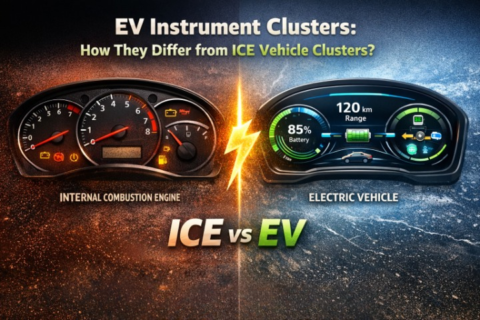
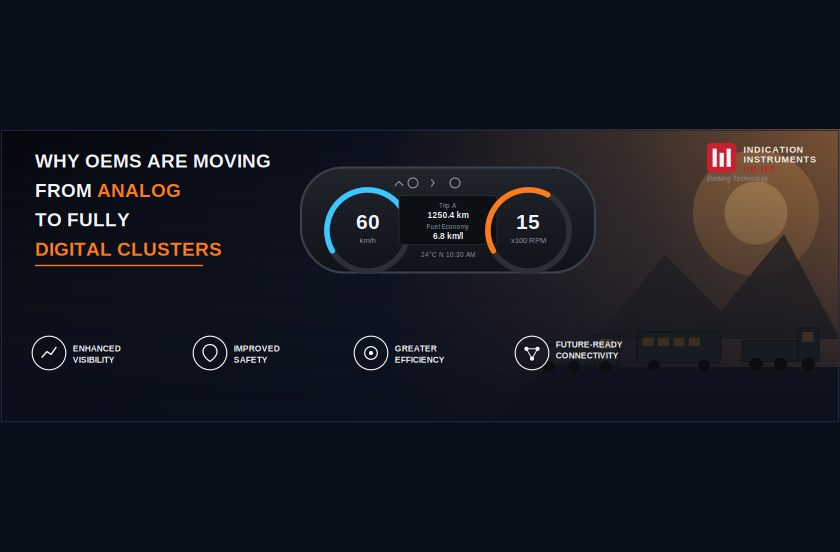
The move is being pulled by three forces at once: electrification, which needs new data types (battery state, range, charging status) that analog gauges can’t show; rising OEM demand for configurable, brand-differentiated dashboards; and safety regulation pushing toward consolidated, distraction-reducing driver information systems. The trend toward integrating HMI and AI systems with instrument clusters is expected to continue, and high-quality displays are needed to support that integration.
How Big Is the Digital Instrument Cluster Market Right Now?
This isn’t a niche shift — it’s a mainstream one. The global automotive digital instrument cluster market was valued at roughly $3.77 billion in 2025 and is projected to reach $4.33 billion in 2026, growing at a 14.7% CAGR, with growth linked to rising adoption of digital displays in vehicles, falling LCD and TFT panel costs, increasing vehicle electrification, and standardization of electronic control units. A separate market view puts the broader digital instrument cluster segment at $8.45 billion in 2025 growing to $9.87 billion in 2026 at an 18.07% CAGR — different scopes, same direction: fast, sustained growth.
Why Are OEMs Choosing Larger, Higher-Resolution Displays?
A key trend is the move toward larger, clearer digital displays that improve readability and interface customization, supporting navigation, vehicle data, and driver-assistance alerts more effectively. For commercial and off-highway equipment specifically, this translates into fewer physical gauges, more consolidated data on a single high-resolution TFT screen, and better legibility for operators working in bright sunlight, dust, or vibration-heavy environments — exactly the conditions covered by IIL’s L10, L10.25, and N12.3 displays.
Is Vehicle Electrification Really Accelerating This Shift?
Yes. Analog gauges were built to show speed, RPM, fuel, and temperature — not battery charge, range, regenerative braking status, or motor temperature. India’s automotive sector is increasingly shaped by AI, IoT, robotics, and software-defined vehicles, with a strong focus on EVs and connected vehicles positioning the country as a leader in sustainable mobility. EV and hydrogen truck, forklift, and genset programs simply need a screen, not a needle, to display this data — a core reason IIL’s own digital display range is purpose-built for EV and hydrogen vehicle applications.
Are AI and Smart HMI Features Becoming Standard in Clusters?
They’re heading that way. The application and integration of HMI and AI systems with instrument clusters is expected to increase, and this requires high-quality displays to support it. For OEMs, that means specifying displays today with enough processing headroom, input flexibility, and firmware-update capability to support smarter features tomorrow — without a full hardware redesign.
What Role Does India Play in Global Digital Cluster Manufacturing?
A growing one. India is projected to see a 23.5% CAGR in the digital instrument cluster market through 2035, among the fastest of any region tracked. That’s consistent with the wider “China+1” sourcing shift, where global OEMs are actively adding India-based electronics manufacturers to reduce single-source risk — a trend covered in more depth in our companion piece on gauge sourcing from India.
What Should OEMs Look for When Choosing a Digital Cluster Supplier?
Four things matter most when specifying a supplier for a multi-year program:
● Protocol compatibility — confirmed CAN2.0B or J1939 support matching your ECU
● Reliability compliance — documented IP65/IP67 and EMC test data, not just datasheet claims
● Update flexibility — UDS bootloader or firmware updates for field servicing
● Manufacturing continuity — a supplier with local engineering support and supply-chain resilience, not a single overseas source
Why Choose Indication Instruments Limited for Digital Clusters?
IIL has manufactured automotive and construction equipment displays for over 30 years, with both Made-in-India and Made-in-USA product lines including the L10.25, N76, and T7i. Every display supports CAN2.0B/J1939 protocols, IP65/IP67 and EMC compliance, and UDS-bootloader field updates, and can be paired with matching gauges, instrument clusters, and sensors & switches for a single-vendor dashboard. Review our quality certificates or product catalogues to start evaluation.
FAQs
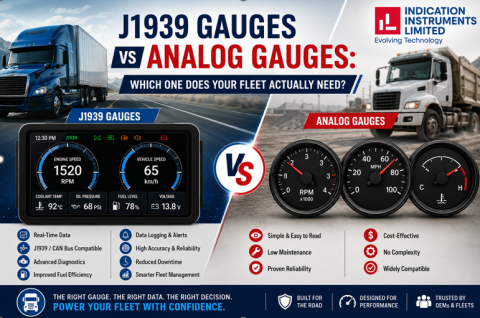
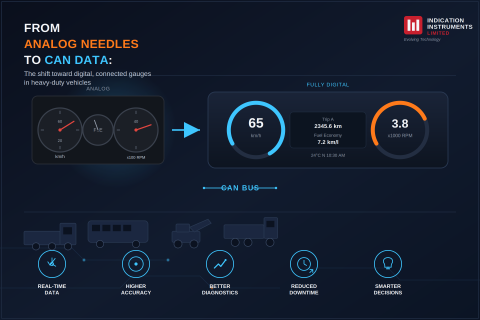
Why are OEMs replacing analog gauges with digital clusters? Analog gauges can’t display the data types modern vehicles need — EV battery status, diagnostics, camera feeds — and digital clusters consolidate this information on one configurable, higher-resolution screen.
Is this shift only happening in passenger cars? No. Commercial vehicles, buses, tractors, construction equipment, and gensets are adopting digital clusters at a comparable pace, driven by electrification and the need for CAN/J1939-based diagnostics.
Do digital clusters cost more than analog gauges? Initial unit cost can be higher, but falling TFT/LCD panel costs and reduced wiring complexity are narrowing the gap, especially at OEM production volumes.
What communication protocol do most digital clusters use? Most commercial and off-highway digital clusters use CAN2.0B or the SAE J1939 protocol, which must match the vehicle’s ECU for proper integration.
Can digital clusters be customized for OEM branding? Yes — resolution, telltale icon sets, startup branding, and layout can typically be customized to match OEM dashboard design requirements.
Ready to specify a digital cluster for your next program? Talk to IIL’s engineering team about CAN/J1939-compliant displays built for commercial and off-highway applications.