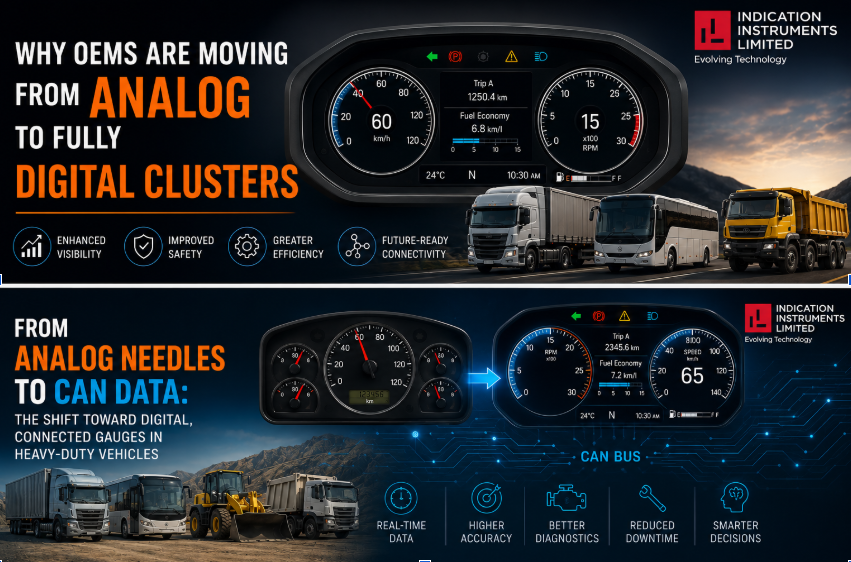
For decades, a needle sweeping across a dial was how a truck driver knew engine temperature,
fuel level, or RPM. That's changing. Heavy-duty vehicles — trucks, buses, gensets, construction
equipment — are increasingly reading these same parameters off a CAN bus, displayed
through connected digital gauges rather than mechanical pointers. Here's why this shift is
happening now, and what it means if you're specifying instrumentation for your next OEM
program.
What’s the Difference Between an Analog Gauge and a Digital, CAN-Connected Gauge?
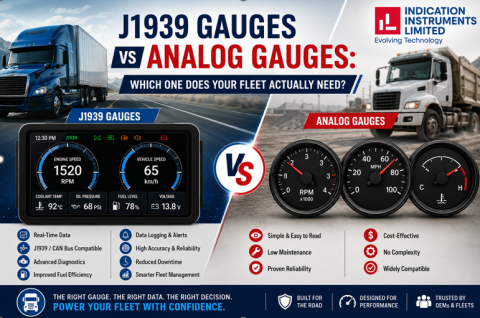
An analog gauge reads a physical signal directly — a sender unit’s resistance, a mechanical pressure line — and moves a needle proportionally. A digital, CAN-connected gauge instead reads data broadcast over the vehicle’s CAN bus (often using the SAE J1939 protocol), then displays it through a stepper-motor pointer, LCD readout, or bar graph. The mechanical result can look similar; the underlying architecture is entirely different, and far more capable.
Why Are Heavy-Duty Vehicles Moving Toward CAN-Based Gauges?
The broader instrument cluster market is seeing systems evolve from traditional analog clusters to advanced digital formats, driven by rapid adoption of innovative technologies across the automotive sector. For heavy-duty and off-highway vehicles specifically, CAN-based gauges solve a problem analog wiring can’t: a single CAN bus can carry dozens of parameters — fuel, DEF/AdBlue level, engine hours, fault codes — over one connector, instead of a dedicated wire and sender for every gauge. That simplifies wiring harnesses and improves diagnostic depth at the same time.
Does Electrification Change What Gauges Need to Display?
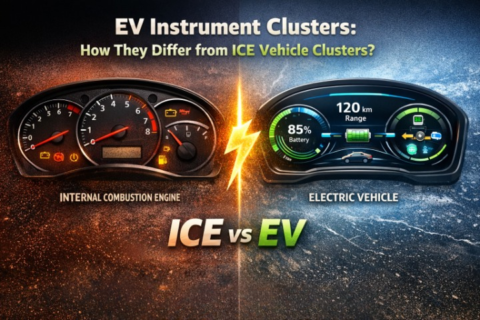
Significantly. India’s automotive sector is increasingly shaped by AI, IoT, robotics, and software-defined vehicles, with a strong push toward EVs, connected vehicles, and sustainable mobility. Traditional fuel and coolant-temperature gauges don’t translate to battery-electric gensets or hydrogen-powered off-highway equipment — but a CAN-connected digital gauge can be reprogrammed to display battery state of charge, motor temperature, or hydrogen tank pressure without changing the physical hardware. This is why IIL’s J1939 gauges are built with reprogrammable displays rather than fixed mechanical scales.
Are Analog Gauges Becoming Obsolete?
Not entirely — and OEMs shouldn’t assume digital is automatically the right answer everywhere. Simple, cost-sensitive applications like basic gensets or entry-level construction equipment still use mechanical temperature and pressure gauges effectively, since they don’t need CAN integration and are cheaper to source and service. The shift toward digital is strongest where the vehicle already has a CAN bus for other systems (engine ECU, transmission, telematics) — at that point, tapping into existing CAN data for gauges is more efficient than running separate analog sender wiring.
What Are the Practical Benefits of CAN-Connected Gauges for Fleet Operators?
1- Fewer wiring failures — one CAN connection replaces multiple analog sender wires, a common failure point in vibration-heavy environments
2- Richer diagnostics — fault codes and threshold warnings can be built into the gauge display itself, not just a separate warning light
3- Easier calibration — pulse and threshold settings can often be configured in the field rather than requiring gauge replacement
4- Consistent data across the dashboard — a CAN-connected gauge and a digital display can show the same underlying data without duplicate sensors
How Should OEMs Decide Between Analog and Digital Gauges?
The decision usually comes down to three questions: Does the vehicle already run a CAN2.0B or J1939 bus for other systems? Does the application need reprogrammable thresholds or multi-parameter display (like a combined fuel/hour meter)? And does the OEM need field-level diagnostic data, not just a dashboard reading? If the answer to any of these is yes, a CAN-connected digital gauge is usually the better long-term choice — even if the upfront unit cost is slightly higher than an analog equivalent.
What Should OEMs Verify Before Specifying a Digital Gauge Supplier?
1- Confirmed support for the exact protocol in use — CAN2.0B or J1939 — not just “CAN compatible” on paper.
2- ISO16750 compliance with documented test reports for vibration, dust, water, temperature & humidity resistance.
3- Field-configurable pulse and threshold settings to avoid re-ordering hardware for calibration changes.
4- A supplier that offers both analog and digital gauge lines, so simpler applications aren’t over-engineered unnecessarily
Why Do OEMs Choose Indication Instruments Limited for Gauge Instrumentation?
IIL manufactures both analog and digital gauges — including speedometers, tachometers, J1939 gauges, and hour meters — engineered for 9V–32V compatibility across 12V and 24V systems, with IP65 and ISO16750-2-compliant construction. As a single-vendor supplier for gauges, digital displays, instrument clusters, and sensors & switches, IIL simplifies sourcing whether your program needs mechanical simplicity or full CAN connectivity. Review our quality certificates or product catalogues to start evaluation.
FAQs
What is a CAN-connected gauge? A CAN-connected gauge reads vehicle data broadcast over the CAN bus — often via the SAE J1939 protocol — instead of a dedicated analog sender wire, and displays it through a stepper-motor pointer or digital readout.
Do CAN gauges require a J1939-compliant vehicle? Yes — the vehicle’s ECU and CAN bus need to broadcast data in a protocol the gauge supports, typically CAN2.0B or J1939, for the gauge to read and display it correctly.
Are digital gauges more reliable than analog ones? Digital, CAN-connected gauges reduce the number of physical sender wires, which lowers one common failure point, but reliability ultimately depends on build quality and environmental compliance (IP rating, EMC) regardless of gauge type.
Can one digital gauge display multiple parameters? Yes — multi-function digital gauges can display fuel level, pressure, voltage, and temperature on a single unit, reducing dashboard clutter.
Should EV or hydrogen vehicle programs use CAN-connected gauges? Generally yes, since these platforms need to display parameters like battery state of charge or hydrogen tank pressure that don’t map to traditional analog sender technology.
Specifying gauges for a heavy-duty or EV program? Contact IIL’s engineering team to discuss analog and CAN/J1939-based gauge options for your application.