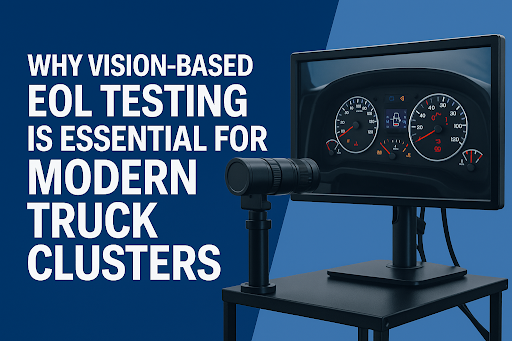
In the automotive industry to make the vehicle more reliable, the need for automatic inspection systems on production lines has increased. Hence, one of the important automated inspections is vision-based end of line testing for truck clusters.
What truck clusters have?
- Multiple Telltale LEDs (Indicator tell tales, Warning Tell tales etc)
- Display screens LCD/TFT (These display Odometer reading, Trip reading, Air pressure bars, DEF gauge, various tell tales etc)
- Pointer based gauges (Speedometer gauge, RPM gauge, Engine temperature gauge, Fuel gauge)
What vision system can check?
- LED presence and color
- Correct Telltale shape
- LCD/TFT digit cuts
- Pointer positions and jerky movements.
How does a vision system work?
A vision system uses a camera to see the cluster and software to judge whether the cluster is OK.
- The camera takes an image of the cluster (dial, pointer, LED, LCD etc).
- The image is taken in a dark area where a camera is mounted at a fix position.
- The software compares the captured image with a pre-teached master image and gives a decision OK or reject.
What are the parts of a vision system?
- Industrial camera with lens to capture the image.
- An enclosed chamber to create a dark area.
- Industrial PC to run the software.
- Mounting fixture for holding the cluster while testing.
- PLC interface for providing inputs for cluster functioning.
Why is manual testing by humans not reliable for truck clusters?
- Human eyes cannot maintain the same accuracy over time due to fatigue. There are more chances of error in human testing.
- Even if the operators are fully skilled for testing they can miss minor defects such as LCD digit cut etc.
- An operator cannot check multiple LEDs and check them one by one which increases the testing time.
- There can be difference in judgement of two operators for the same cluster.
Vision system removes human dependency and ensures consistence testing.
What are the benefits of a vision-based system?
- Vision systems never get tired, distracted, or inconsistent.
Example: While checking telltale LEDs, a human operator may sometimes miss a defect, but the vision system will detect the defect repeatedly.
- Vision systems are faster compared to manual inspection.
Example: While checking multiple telltale LEDs a operator will check them one by one but the vision system can check them together.
- No need to rely on highly skilled manpower for visual judgment.
- Using the vision system will reduce the defects passing to the customer, resulting in customer satisfaction.
- Using a vision system will reduce zero KM failures resulting is reduction in cost of quality and improving customer satisfaction.
What are the Limitations of vision-based System?
- Vision setups are very expensive.
- Cannot detect all electrical, mechanical and software defects such as fitment issues, Buzzer failure, Can communication errors etc.
- Needs very accurate teaching of each variant.
- Can give false OK and false rejections if teaching is not accurate.
- Requires a dark area for placing the test part and camera.
- Breakdown times are longer and difficult troubleshooting resulting in higher MTTR.
Challenges in testing pointer based gauges:
- The pointer appears at different positions when viewed from different angles.This causes parallax error.
- Some pointers are reflective due to which their edges become hidden.
- Pointer has a dynamic behavior but the vision system used static images, this mismatch causes challenges in accurately detecting pointer positions.
- The use of static images in vision system causes challenges in detecting jerky and sticky pointer movements.
- When the camera captures the image of a moving pointer , there are chances of getting blur images causing false rejections.
What Softwares and technologies are used in Vision systems?
- NI vision
- Labview vision
- Cognex vision Pro
- Halcon machine vision software
Some technologies used are:
- Optical character recognition
- Color analysis
- Edge detection
- Pixel comparison
FAQs: EOL testing vs HIL testing
What does an EOL vision system check?
EOL mainly focus on:
- Hardware defects
- Display defects
- LED/Telltales issues
- Pointer alignment
EOL ensures cluster is defect free in hardware aspects before shipment.
What does a HIL(Hardware in loop) system check?
HIL focus on:
- Software logic
- Communication protocols (CAN)
- Internal algorithms
- Calibration checks.
HIL is used during development, validation and software release cycles.
Why is vision-based testing more suitable for high-volume production lines?
It enables inspection of several parameters simultaneously, such as LEDs, LCD segments, and pointer positions, among others, at very high speed. This makes them very ideal for mass production environments where consistency, speed, and accuracy are critical. Unlike manual operators, vision systems do not slow down over time, ensuring stable cycle times and higher throughput.
Can a vision-based system detect intermittent or temperature-dependent defects?
Although vision systems are great for detecting visual and appearance defects, some intermittent or temperature-dependent problems—like intermittent backlight flicker, thermal LCD defects, or pointer stiction at variable temperatures—may not get detected. In those cases, special endurance rigs or environmental chambers and HIL testers are needed along with the vision-based inspection.