Introduction: One Screen, A Machine’s Worth of Information
I attended an agricultural machinery exhibition a few years back where a single combine harvester had its cab redesigned around a large format multifunction display. The machine previously used eleven separate analog gauges and three toggle-monitored warning lights. The new setup consolidated everything into one configurable screen. A technician standing next to me, who had been servicing these machines for over two decades, looked at it for a moment and said: ‘That is the first time I have understood what a combine is actually doing just by looking at the dash.’
That observation has stayed with me because it captures what multifunction digital displays are supposed to accomplish. Not to add complexity, but to reduce it. Not to impress with features, but to give an operator a clear, prioritized view of a complex machine’s operational state.
The global agricultural equipment market is projected to reach USD 230 billion by 2027, according to Grand View Research. The construction equipment segment sits alongside it at approximately USD 215 billion. Both industries are in the middle of a significant digital instrumentation transition, driven by telematics integration requirements, emissions compliance monitoring, and the growing penetration of precision agriculture and job site management platforms. Multifunction digital displays are at the center of that transition.
This post examines what multifunction displays actually need to do in these applications, how construction and agricultural requirements differ from each other, and what technical specifications drive sound procurement decisions.
What Multi-Function Actually Means in Practice
The term multifunction gets applied loosely across the display market. Before any specification conversation, it is worth being precise about what the function set actually needs to cover.
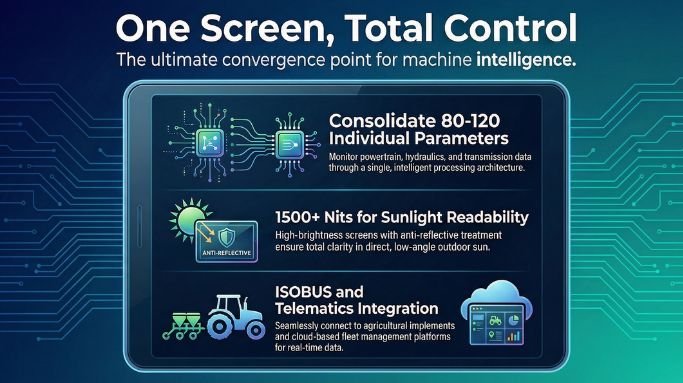
Parameter consolidation: A multifunction display in a combine harvester or wheel loader needs to handle sensor inputs from the powertrain, hydraulic system, transmission, and cabin environment simultaneously. In a modern combine, that means 80 to 120 individual parameters are potentially displayable. The display needs the processing architecture to read all of them and the screen real estate to present the relevant ones intelligently.
Multi-network CAN capability: Agricultural and construction equipment routinely runs multiple CAN networks. The engine and powertrain typically operate on one network. Body and implement systems operate on another. An ISOBUS-connected implement adds a third. A display that can only read one CAN network will miss critical operational data in most professional applications.
Configurable display zones: Operators in different roles configure their information differently. A harvesting operator prioritizes grain yield, moisture content, and header height. A transport driver on the same machine prioritizes road speed and fuel level. A good multifunction display allows operator-defined configurations that switch contextually.
Alert prioritization and alarm management: The most important function of any multifunction display is making sure critical alerts are not lost in a sea of normal operating data. SAE J1939 defines severity classifications for diagnostic trouble codes. The display must respect those classifications and present critical alerts with appropriate urgency without rendering normal parameter displays unusable.
Indication Instruments’ range of
multifunction digital displays is engineered to handle these multi-network, multi-parameter requirements in the demanding environments that construction and agricultural equipment imposes.
Construction Equipment: What the Application Demands
Construction equipment encompasses a wide range of machine types, each with its own display requirements. Excavators, wheel loaders, motor graders, compactors, and articulated haul trucks share a common theme: they operate in outdoor environments with significant vibration, dust exposure, and variable lighting, and they are increasingly expected to feed data into job site management platforms.
The most consistent display requirement I hear from construction fleet operators is sunlight readability. A display that performs perfectly in a controlled environment becomes functionally useless when the machine is operating with the afternoon sun at a low angle through the cab windscreen. Minimum 1500 nit display brightness with anti-reflective cover glass treatment is a practical floor for serious outdoor construction applications.
Telematics integration for machine utilization reporting is the second most consistent requirement. Equipment rental companies and large contractors increasingly run centralized asset management platforms that need real time data on machine hours, fuel consumption, fault status, and GPS position. The multifunction display in the cab is the node through which telematics data becomes visible to the operator, and the TCU integration behind the display is what feeds the asset management platform. Specifying a display that supports TCU integration from the start avoids costly retrofit work later.
According to McKinsey, digital fleet management for construction equipment reduces equipment idle time by 15 to 25 percent. At the utilization rates and fuel consumption levels of large construction machinery, that reduction translates to meaningful cost recovery.
Agricultural Equipment: The ISOBUS Requirement
Agricultural equipment has a specific integration requirement that separates it from most other off-highway vehicle categories: ISOBUS. Defined by ISO 11783 and built on J1939 architecture, ISOBUS enables the tractor display to communicate directly with attached implements, showing implement-specific parameters and allowing operator control of implement functions from the cab display.
In practical terms, this means a seed drill attached to a tractor communicates its section control status, seed rate, blockage alarms, and actual application rate directly to the tractor’s multifunction display. A fertilizer spreader sends its application rate and GPS section status. A baler sends bale count and chamber pressure. Without ISOBUS capability in the display, all of this information is either inaccessible or requires separate implement-mounted displays, which fragment the operator’s attention and complicate the cabin ergonomics.
Precision agriculture is accelerating the data demands on these displays. Variable rate application systems, GPS guidance overlays, yield mapping integration, and field management platform connectivity are all capabilities that professional arable and livestock farmers now expect as standard in premium equipment. The multifunction display is the convergence point for all of it.
The global precision agriculture market is projected to reach USD 14.5 billion by 2027, according to MarketsandMarkets. That growth is being driven by the integration of GPS, sensor, and display technology that makes variable rate application and yield monitoring operationally practical. The display platform is the linchpin of that integration.
Key Capabilities by Equipment Type: A Comparison
The table below outlines the core multifunction display capabilities required across construction, agricultural, and mining equipment categories. Requirements vary more than product specifications typically acknowledge.
| Capability | Construction Equipment | Agricultural Equipment | Mining Equipment |
| Primary Protocol | J1939, CANopen | ISOBUS (ISO 11783), J1939 | J1939, CANopen, proprietary OEM |
| Minimum Display Brightness | 1500 nits (outdoor operations) | 1500 nits (field operations) | 2000 nits (direct sun exposure) |
| Multi-Network CAN | 2 networks minimum | 3 networks (tractor + implement + GPS) | 3 to 4 networks standard |
| ISOBUS Task Controller | Rarely required | Mandatory for implement control | Not applicable |
| Telematics Integration | Job site management platform | Field management system, AgTech platform | Mine management and dispatch system |
| Data Logging | Machine hours, fuel, fault events | Yield data, application rates, GPS tracks | Payload cycles, tyre pressure, downtime events |
| Alarm Management Levels | 3 tier (advisory, caution, critical) | 3 tier plus implement-specific warnings | 4 tier including safety interlock states |
| Operating Temperature | Minus 20 to plus 70 degrees C | Minus 40 to plus 70 degrees C | Minus 40 to plus 85 degrees C |
| GPS Overlay Support | Job site mapping (optional) | Field boundary and guidance (standard) | Haul route and pit mapping (required) |
Technical Specifications That Drive Procurement Decisions
Screen size gets a lot of attention in display procurement conversations. It matters, but it is rarely the most important specification. The criteria that separate a display that works in an agricultural cab from one that fails at month six in the same application are environmental tolerance, protocol depth, and processing architecture.
Processing capacity: Multifunction displays need sufficient processing headroom to handle CAN message parsing, display rendering, alert processing, GPS data management, and telematics communication simultaneously. Displays that perform adequately in bench testing can suffer rendering latency or missed alarms when all subsystems are active simultaneously in a field environment. Asking for demonstrated performance under full load, not peak theoretical specifications, is the right evaluation approach.
Memory and data logging: Precision agriculture and construction telematics both depend on reliable local data logging when cellular connectivity is unavailable. A display that loses operational data because it lacks sufficient onboard storage defeats a significant part of its purpose in field applications. Ask for specific local storage capacity and logging interval specifications.
Connectivity options: Bluetooth pairing for operator configuration via tablet, Wi-Fi for job site hotspot connectivity, and cellular modem integration for real time fleet platform communication are all relevant connectivity requirements in modern equipment. Not every application needs all three, but understanding which connectivity modes the display supports natively versus requiring external hardware saves integration complexity.
Exploring the full product range at Indication Instruments is a practical starting point for construction and agricultural equipment programs where multifunction display specifications need to be matched to specific operational requirements.
Where This Technology Is Heading
Two developments are shaping the next generation of multifunction display deployments in construction and agricultural equipment.
Autonomous and semi-autonomous equipment is arriving in both sectors. Autonomous haul trucks are already operating in large surface mining sites. Autonomous tractors are in commercial deployment with multiple manufacturers. The instrument cluster in these machines shifts from an operator interface to a remote supervision and intervention interface. The display architecture, processing requirements, and connectivity demands of autonomous operation are substantially different from conventional operator-present applications. Display platforms selected for the next equipment generation need to be evaluated with that transition in mind.
Cloud integration for real time job site and field management is becoming a baseline expectation rather than a premium feature. Contractors and large farming operations increasingly expect live machine data in browser-based management platforms without manual data transfer. The multifunction display is the on-machine endpoint of that data pipeline. Its ability to connect reliably to cloud platforms via cellular or site Wi-Fi and transmit structured operational data determines the practical value of the broader management system.
Reach out to the team at Indication Instruments to discuss multifunction display specifications for your construction or agricultural equipment program.
Frequently Asked Questions
Q1: What is the difference between a multifunction display and a standard instrument cluster?
A standard instrument cluster displays a fixed set of vehicle parameters from a single data source. A multifunction display handles multiple data sources simultaneously, typically across more than one CAN network, and provides configurable display layouts that the operator can adjust based on operational context. In agricultural applications, this includes ISOBUS implement integration. In construction applications, it includes job site telematics data alongside machine operating parameters.
Q2: Is ISOBUS compatibility mandatory for all agricultural equipment displays?
ISOBUS is mandatory for any display intended to interface with modern precision agriculture implements, including GPS-guided sprayers, planters with section control, and yield-mapping harvesters. For simpler applications such as standalone tractors with non-ISOBUS implements, standard J1939 capability may suffice. The defining question is whether the application requires implement-specific parameters and control functions to appear on the tractor display.
Q3: What screen size is appropriate for agricultural and construction cab applications?
Seven to ten inch diagonal displays are the most common range for single-display cab installations in agricultural and construction equipment. Larger twelve to fifteen inch formats are increasingly used in premium tractors and graders where the cab space allows and the information density justifies the screen real estate. The more important specification is often pixel density and cover glass quality rather than physical size alone.
Q4: How does data logging work in remote field operations without cellular connectivity?
Quality multifunction displays include onboard storage, typically 8 to 32 GB of internal memory, for local data logging during field operations outside cellular coverage. When connectivity is reestablished, the display or an integrated telematics module transmits the buffered data to the fleet or field management platform. Evaluating the logging interval, buffer size, and transmission priority protocol is important for applications with extended periods of low connectivity.
Q5: What certifications should I require for a construction equipment multifunction display?
E-mark certification is required for equipment that will operate on public roads in European markets. CE marking is required for equipment sold in the EU. For off-highway construction applications, IP67 minimum for dust and water resistance and MIL-STD-810G or equivalent vibration testing are practical requirements. ISO 13766 specifically covers earthmoving machinery and is the most directly relevant vibration standard for construction equipment display procurement.
Q6: Where can I find multifunction displays suited to construction and agricultural applications?
Indication Instruments offers a range of digital display solutions engineered for the environmental and protocol requirements of construction and agricultural equipment. Visit the product catalog or contact the team for an application-specific recommendation.
Related Articles
- Advanced Digital Instrument Clusters for Heavy Duty Trucks and Industrial Vehicles
- SAE J1939 and ISOBUS Protocol Guide for Agricultural Equipment Engineers
- Digital Display Selection Guide for Industrial and Automotive Applications
- How Fleet Telematics Is Transforming Construction Site Management
- Rugged Instrument Clusters for Off-Highway Vehicles: Features and Benefits