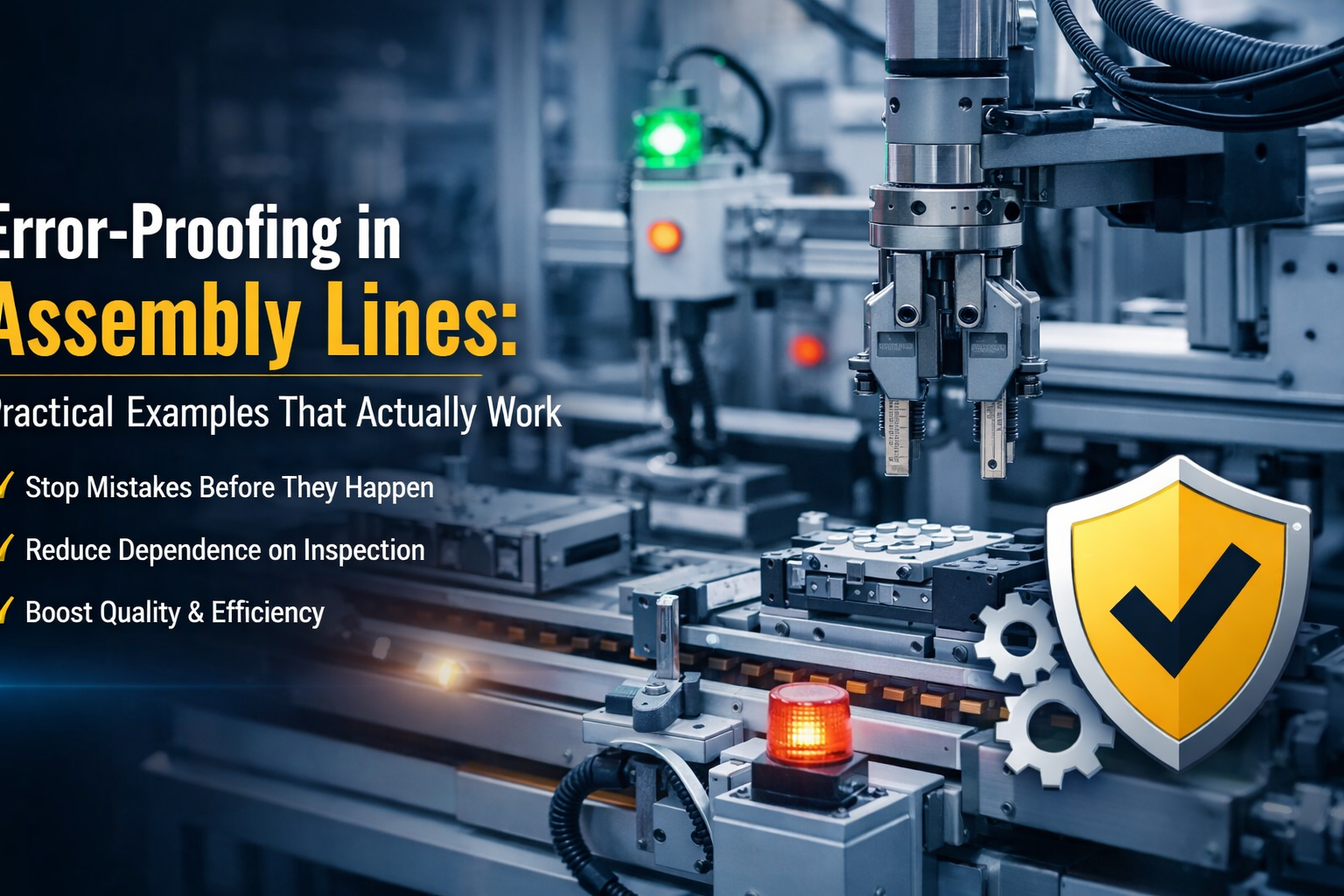
How Error-Proofing Slowly Removes the Need for Inspection?
In most factories, quality still depends heavily on inspection. We inspect incoming parts, inspect after every critical operation, inspect at the end of the line, and sometimes even inspect again before dispatch. On paper, this feels safe. In reality, it usually means the process itself is not fully trusted.
Automation was supposed to solve this problem. But in many automated lines, manufacturing Gauges, Instrument Clusters, and Digital Display systems inspection remains almost the same as before—just faster and more expensive. The real improvement in quality does not come from adding more inspection points. It comes from error-proofing the process so that mistakes simply cannot happen.
Inspection exists because we expect something to go wrong. If the process were truly reliable, inspection would be minimal. But over time, inspection becomes a habit. When a defect occurs, the first reaction is often, “Add one more check.”
The problem with this approach is simple:
- Inspection finds defects after they are already made
- It depends on human attention and judgment
- It slows down the line
- It hides weak processes instead of fixing them
Anyone who has worked on the shop floor knows that even 100% inspection does not guarantee zero defects. Fatigue, pressure, and routine make mistakes inevitable.
Error-proofing takes a different approach. Instead of asking people to “be careful,” it changes the process so that being careless is no longer possible.
What Error-Proofing Really Means in Automation
Error-proofing in automated lines does not mean installing expensive vision systems everywhere. It means thinking ahead and asking one simple question at every step:
“How can this operation go wrong—and how can I stop it before it happens?”
Sometimes the solution is electronic. Sometimes it is mechanical. Often, it is just good logic in the PLC.
The best error-proofing solutions are usually:
- Simple
- Reliable
- Hard to bypass
- Easy to maintain
Also Read: Problem-solving that actually sticks: Practical techniques and why 8D works for us
Practical Error-Proofing Examples from Automated Lines
1. Part Presence and Orientation Checks
One of the most common causes of defects is wrong part loading or incorrect orientation.
This is especially common in assembly of Gauges and Digital Display units, where alignment and connector placement must be perfect Operators may be trained, but in high-volume production, mistakes happen.
A simple sensor or vision check before cycle start can confirm:
- Part is present
- Part is in the correct position
- Part is seated properly
If the condition is not met, the machine simply does not start.
This immediately removes the need for an operator or inspector to visually confirm the part. The machine takes responsibility, and the operator only responds if there is an alarm.
2. Forcing the Right Sequence
In manual or semi-automatic lines, operators sometimes skip steps—usually to save time, sometimes by mistake.
In a well error-proofed automated line, the sequence is locked. The next step is enabled only when the previous step is completed correctly and confirmed by a sensor or signal.
This means:
- No step can be skipped
- No step can be done twice
- No step can be done out of order
Once this is in place, inspection for “missed operations” becomes unnecessary because the process itself guarantees completion.
3. Torque and Force Monitoring
Fastening and press-fit operations are sensitive and often responsible for major quality issues.
Instead of checking torque or fitment later, modern automated lines monitor:
- Applied torque
- Angle
- Press force
- Final position
If the values are outside limits, the system immediately flags the issue or stops the process.
This is far more reliable than checking bolts or fitment afterward. Numbers don’t lie, and machines don’t “feel” differently at the end of a long shift.
4. Position and Height Verification
Many defects happen because something is almost right, but not fully correct. A component looks fitted, but it is not seated fully.
Using simple height sensors, encoders, or probes, the machine can confirm:
- Final height
- Insertion depth
- End position
Once this is validated automatically, there is no need for visual inspection at that station. The machine already knows whether the operation was successful.
5. Fixture and Clamp Interlocks
Running a machine without proper clamping or with a wrong fixture can damage parts, tools, or even cause safety incidents.
Limit switches and proximity sensors can confirm:
- Fixture is present
- Clamp is fully closed
- Tool is correctly mounted
If any condition is not satisfied, the machine refuses to run. This eliminates reliance on operator attention and removes the need for pre-operation inspection.
6. Variant and Model Control
In multi-variant production, part mix-ups are a major risk. This is critical for products like Instrument Clusters and Digital Display models, where different variants require different configurations, Training alone is never enough.
Barcode or RFID systems allow the machine to verify:
- Correct part number
- Correct model
- Correct program loaded
If there is a mismatch, the line stops immediately. This makes inspection for variant correctness almost irrelevant because the process itself blocks errors.
7. Rejecting Defects Immediately
One of the biggest weaknesses in many lines is allowing defects to move forward.
Effective error-proofing ensures that:
- A defective part is rejected immediately
- It cannot move to the next station
- It cannot be mixed with OK parts
When defects are stopped at the source, end-of-line inspection and sorting reduce drastically.
How Error-Proofing Slowly Removes the Need for Inspection?
When error-proofing is done properly, something interesting happens over time. Inspection levels start reducing naturally.
This happens because:
- The process becomes predictable
- Defects stop repeating
- Confidence in the line increases
- Quality becomes stable, not reactive
Inspection then changes its role. Instead of checking every part, quality teams focus on:
- Process audits
- Trend analysis
- Continuous improvement
Inspection becomes a confirmation, not a rescue activity.
Common Mistakes That We All Make
Many error-proofing attempts fail because:
- Systems are over-engineered
- Bypasses are easily available
- Alarms are ignored
- Maintenance is not involved
- Detection is mistaken for prevention
True error-proofing does not just raise an alarm. It prevents the mistake from going further.
The Role of Process Engineers
Error-proofing is not the responsibility of machine suppliers alone. Process engineers play a key role by:
- Studying past defects
- Identifying weak steps
- Converting inspection points into prevention points
- Driving small but effective upgrades
Even one good error-proofing improvement every month can completely change the stability of a line.
Final Thoughts
Inspection will never disappear completely—and it shouldn’t. But when inspection becomes the main quality control method, it is a sign that the process needs improvement.
Error-proofing strengthens the process so that quality is built in, not checked in.
The best automated lines are not the ones with the most inspectors. They are the ones where nothing can go wrong unless something abnormal happens—and when it does, the system reacts immediately.
In the end, the strongest quality system is not the one that catches every defect, but the one that doesn’t allow defects to exist at all. Error-proofing is increasingly important in industries producing Gauges, Instrument Clusters, and Digital Display products, where reliability and accuracy are essential.
Frequently Asked Questions (FAQ)
Is error-proofing suitable only for fully automated assembly lines?
No. Error-proofing works in manual, semi-automatic, and fully automated lines. Simple solutions like interlocks, sensors, and sequence checks are often more effective than complex automation.
Can error-proofing completely eliminate inspection?
No. Inspection cannot be removed completely, but effective error-proofing greatly reduces the need for frequent and repetitive inspections by preventing defects at the source.
Is error-proofing expensive to implement?
Not necessarily. Many effective error-proofing solutions use simple sensors, mechanical guides, or PLC logic. These are often far cheaper than ongoing inspection, rework, and scrap costs.
How do you decide where to apply error-proofing first?
Start with processes that have repeated defects, high rework, or safety risks. Past quality data and operator feedback are the best inputs for identifying error-proofing opportunities.