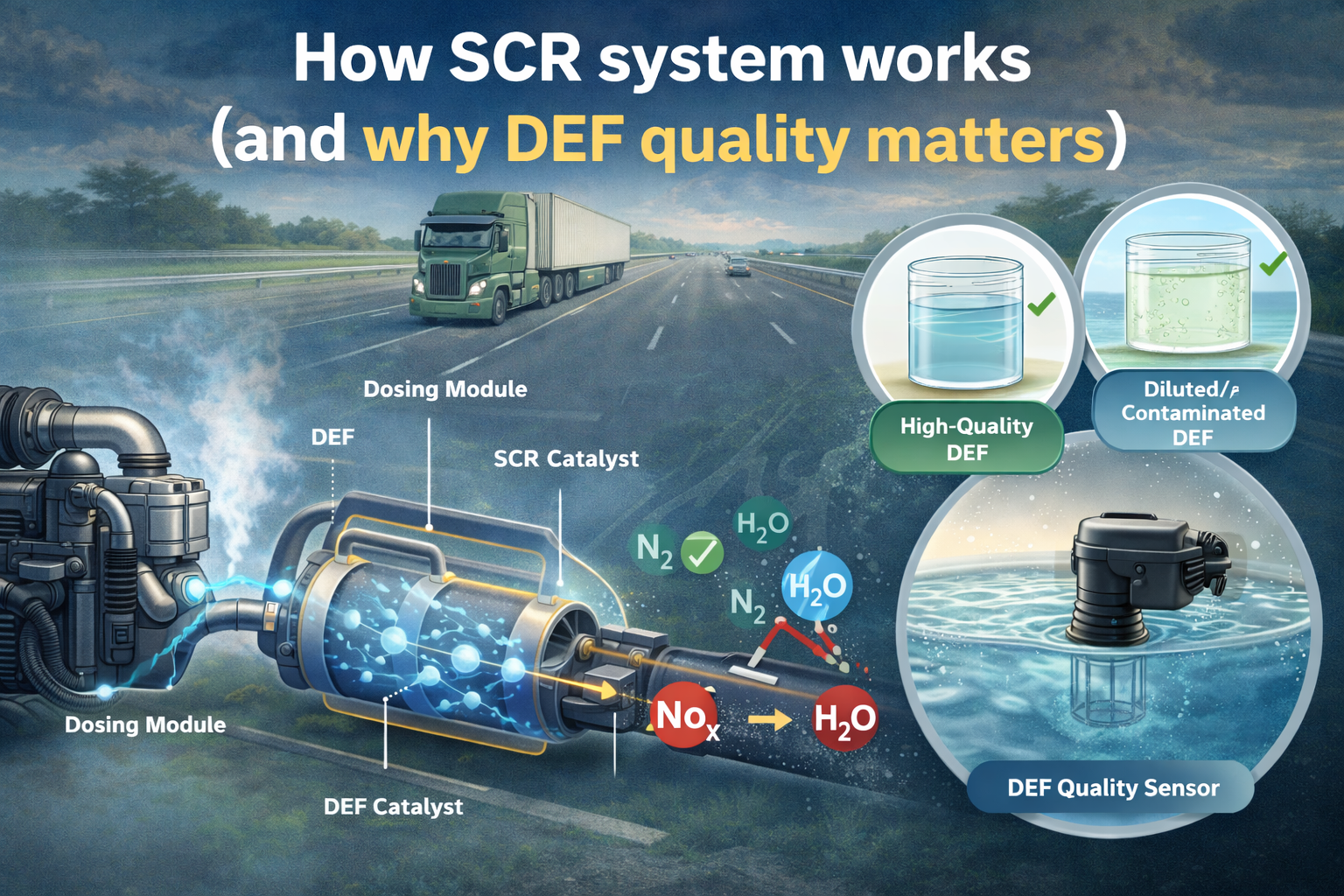
Modern diesel vehicles use Selective Catalytic Reduction (SCR) to cut NOx emissions (nitrogen oxides) in the exhaust. The core idea is simple:
- Exhaust leaves the engine carrying NOx.
- A dosing module injects DEF (Diesel Exhaust Fluid)—also called AdBlue in many markets—into the hot exhaust stream.
- DEF is an aqueous urea solution (nominally 32.5% urea in deionized water). In the exhaust, urea breaks down to form ammonia (NH₃).
- Inside the SCR catalyst, ammonia reacts with NOx and converts it into nitrogen (N₂) and water (H₂O).
If the system doses the right amount of DEF, at the right time, and the catalyst is healthy, NOx emissions drop dramatically.
Where the DEF quality sensor fits
The SCR controller assumes DEF has the correct urea concentration. If DEF is:
- diluted with water,
- contaminated, or
- wrong fluid entirely,
then ammonia generation is off, dosing control becomes inaccurate, and NOx reduction suffers. That can lead to:
- emissions non-compliance,
- catalyst or dosing faults,
- crystal deposits / clogging risks (from improper dosing and evaporation behaviour), and
- repeated warning lamps / limp-home strategies.
So a DEF quality sensor is essentially an “input-truth” sensor: it verifies the fluid is what the ECU thinks it is, so the SCR system can function reliably across real-world usage.
Why DEF quality sensing is critical in BS6 vehicles
BS6 (Bharat Stage VI) tightened allowable emissions significantly, especially NOx for diesels, which pushed SCR adoption across many vehicle segments in India.
Regulations also require that emission control systems are not easily defeated or bypassed. In practice, that means vehicles must detect and respond to:
- wrong / low-quality DEF,
- empty tanks,
- dosing malfunctions, and
- emissions-control tampering.
Typical responses include warnings, inducements (e.g., reduced torque), and diagnostic trouble codes. That makes DEF quality sensing not just a performance feature but a compliance and durability necessity—because sustained NOx non-control can put the vehicle out of regulatory conformity.
Two main approaches to DEF quality sensing
Most DEF quality sensors aim to estimate urea concentration (and sometimes infer contamination) by measuring how the fluid interacts with light or sound. The two widely used families are:
- Optical sensing (often using refractive index / light transmission behavior)
- Ultrasonic sensing (using sound velocity / acoustic attenuation)
Both technologies exist because DEF is tricky:
- It’s water-based, but not just water.
- Concentration must be close to nominal for correct ammonia generation.
- It can freeze, warm up, age, and pick up air bubbles or crystals.
- The sensor sits in a harsh underbody environment: temperature cycling, vibration, contamination, chemical exposure, and connector issues.
How optical DEF quality sensing works
Principle (in simple terms)
Optical sensors shine light through or into the fluid and measure how it behaves—commonly through:
- Refractive index (RI): how strongly the fluid bends light.
- Transmission / absorption: how much light passes through at certain wavelengths.
- Backscatter / reflection: how light reflects based on fluid properties.
Because urea concentration changes the optical properties of the solution, the sensor can estimate concentration when combined with temperature compensation.
Evolution: why optical became attractive
Optical methods matured fast due to:
- Low-cost, robust LEDs and photodiodes
- Better optical plastics, windows, and sealing methods
- Compact opto-mechanical packaging suited to tank modules
- Mature signal processing (filtering noise, compensating temperature and aging)
How it’s used in DEF quality sensing
A typical design has:
- Light source (LED)
- Optical path or prism/window contacting the DEF
- Detector (photodiode)
- Temperature sensor (very important)
- Calibration curve mapping optical signal → concentration
How ultrasonic DEF quality sensing works
Principle (in simple terms)
Ultrasonic sensors send a high-frequency sound wave through the fluid and measure:
- Speed of sound in the fluid (changes with concentration and temperature)
- Attenuation (how quickly the sound weakens), which can also be influenced by bubbles and contamination
- Sometimes time-of-flight and amplitude patterns
Because urea concentration changes density and compressibility, it changes the speed of sound—again requiring strong temperature compensation.
Evolution: why ultrasonic gained popularity
Ultrasonic sensing benefited from:
- Better low-power piezo transducers
- Improved timing electronics (precise time-of-flight measurement)
- Automotive-grade digital processing
- Strong packaging learning from ultrasonic parking sensors and flow meters
How it’s used in DEF quality sensing
A typical design has:
- One or two ultrasonic transducers
- A defined acoustic path length inside a chamber or across a sensor face
- Electronics to measure time-of-flight and/or amplitude
- Temperature sensor + calibration model
Advantages and limitations: Optical vs Ultrasonic
Optical sensing — advantages
- High sensitivity to concentration changes (especially with refractive index methods)
- Fast response
- Can be compact with simple electronics
- Often cost-effective at scale
- Can be designed to be low power
Optical sensing — limitations
- Window fouling / deposits: crystallization, films, or contamination on the optical surface can skew readings.
- Aging of optics: LED output drift, photodiode sensitivity drift, yellowing of plastics over long life (depends on materials and design).
- Bubbles / turbidity can disrupt the light path.
- Needs good mechanical design to avoid false readings due to partial wetting, film formation, or trapped air.
Typical real-world failure modes: gradual signal drift due to optical path contamination, seal/window issues, connector ingress, or misreads during freeze/thaw transitions.
Read More: https://indicationinstruments.com/how-shingo-model-improves-product-quality-automotive-sensors/
Ultrasonic sensing — advantages
- No “clear window” requirement in the same way as optical; can be less sensitive to surface staining.
- Can be relatively robust to some forms of optical contamination/turbidity.
- Speed of sound measurement can be very repeatable with good temperature compensation.
- Can sometimes provide extra diagnostics (bubbles, aeration, fill state indicators) depending on implementation.
Ultrasonic sensing — limitations
- Air bubbles are a big enemy: aeration can severely disturb ultrasonic transmission.
- More sensitive to mechanical coupling and mounting: path length and alignment matter.
- Electronics can be more complex (precise timing, signal conditioning).
- DEF freezing and crystal formation can affect acoustic behavior near the sensor face.
- In some designs, attenuation changes can be difficult to interpret uniquely (concentration vs bubbles vs contamination).
Typical real-world failure modes: intermittent readings from aeration, mounting stress, transducer aging, or edge-case errors during slosh/fill events and freeze/thaw.
Which technology is more preferred (especially considering warranty / failures)?
General industry tendency (practical view)
- Optical can be excellent when the design strongly mitigates window fouling (good flow around the optical face, self-cleaning geometry, smart filtering/diagnostics). But if fouling is not controlled, optical drift leads to customer-visible issues (false poor quality, repeated warnings).
- Ultrasonic avoids classic “dirty window” issues but is often more vulnerable to bubbles/aeration, which can be common during refills, return flow, and slosh—potentially causing intermittent faults if filtering and algorithms aren’t strong.
A practical recommendation for “warranty robustness”
- If the vehicle duty cycle often includes frequent refills, slosh, and aeration, and the packaging cannot ensure stable fluid contact, optical may produce fewer intermittent faults (provided the optical surface is protected against deposits).
- If the system historically struggles with crystal/deposit build-up at the sensor face or the tank environment is prone to contamination films, ultrasonic may be preferred due to reduced dependence on optical clarity—as long as the design handles bubbles well.
Best-practice design notes (what reduces failures for both)
Regardless of technology, the best warranty outcomes usually come from:
- Strong temperature measurement and compensation (DEF properties vary heavily with temperature)
- Freeze/thaw-aware algorithms (ignore readings during transition, confirm stability)
- Debounced diagnostics (avoid triggering faults on short-term disturbances)
- Mechanical design that ensures consistent wetting and minimizes trapped air
- Service-friendly diagnostics (differentiate “bad DEF” vs “sensor issue” vs “aeration event”)
Closing: what the future looks like
As BS6 (and global) emission enforcement strengthens, DEF quality sensing is moving toward:
- better multi-parameter sensing (concentration + contamination heuristics),
- smarter diagnostics to reduce false warnings,
- improved materials to fight deposits and long-term drift,
- and designs that remain stable across harsh real-world conditions.
Optical and ultrasonic sensing are both proven. The “winner” is usually the one that best matches the tank hydraulics, packaging constraints, and diagnostic philosophy—not just the physics.